
INTELIGENCE HUB
INTELIGENCE HUB
Frameworks
Frameworks
Web3 growth is driven by systems, not campaigns.
These frameworks map narrative, distribution, and signal from early attention to liquidity and ecosystem growth.
Web3 growth is driven by systems, not campaigns. These frameworks map narrative, distribution, and signal from early attention to liquidity and ecosystem growth.
How do decentralized systems achieve adoption at scale?
How do decentralized systems achieve adoption at scale?
At MOIC, we study this question through a set of conceptual frameworks designed to explain how marketing operates inside decentralized ecosystems.
These frameworks are based on ecosystem observation, research, and practical experience working with Web3 companies.
Together, they form what we call The MOIC Web3 Marketing Canon.
Rather than describing isolated tactics, the Canon maps the systems that connect narrative, distribution, participation, and liquidity across open digital networks.
The following frameworks represent the core models we use to understand how Web3 ecosystems grow.
At MOIC, we study this question through a set of conceptual frameworks designed to explain how marketing operates inside decentralized ecosystems.
These frameworks are based on ecosystem observation, research, and practical experience working with Web3 companies.
Together, they form what we call The MOIC Web3 Marketing Canon.
Rather than describing isolated tactics, the Canon maps the systems that connect narrative, distribution, participation, and liquidity across open digital networks.
The following frameworks represent the core models we use to understand how Web3 ecosystems grow.
The MOIC Web3 Marketing Framework
The MOIC Web3 Marketing Framework
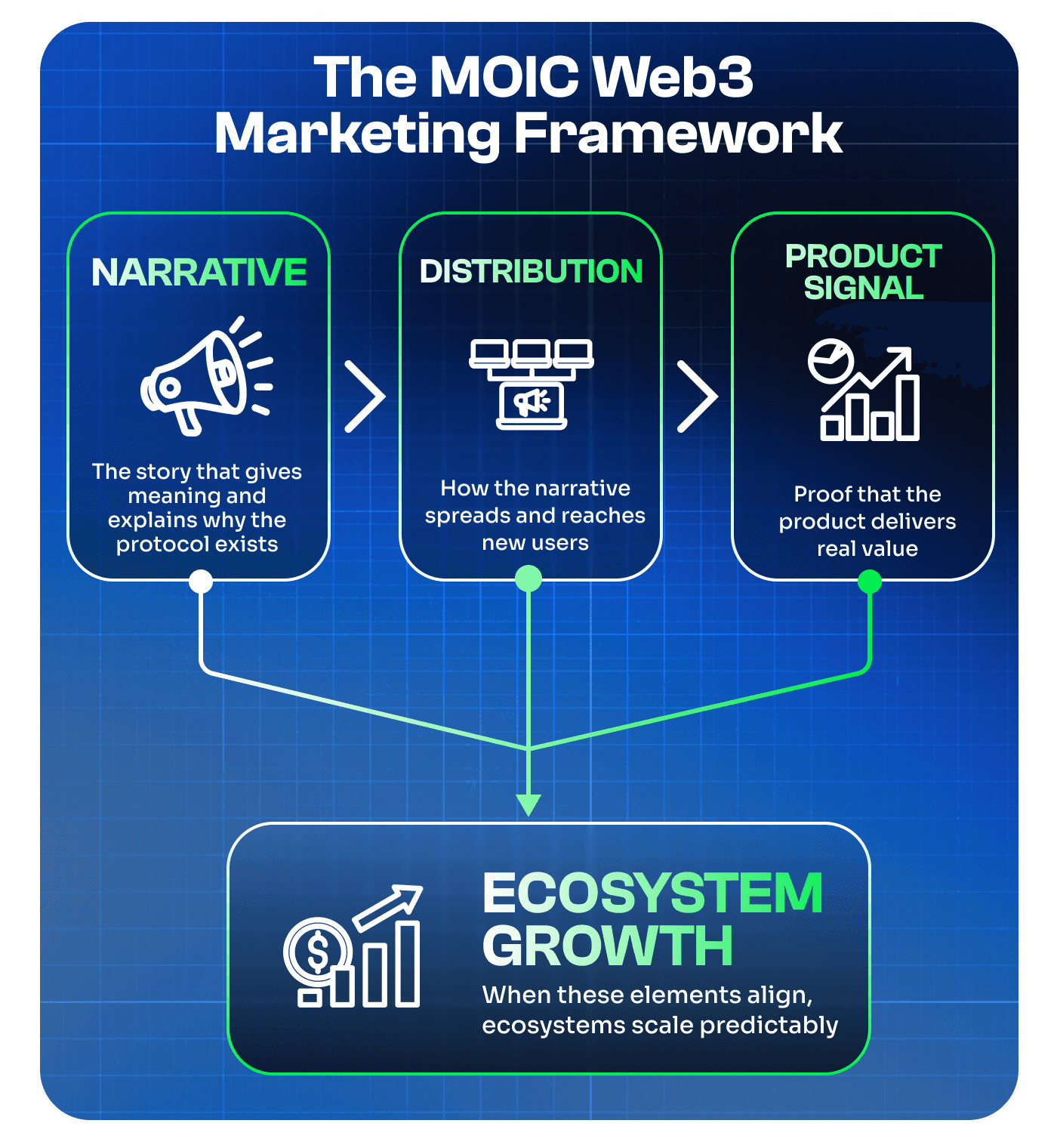
The foundation of Web3 Marketing lies in the interaction between three elements:
Narrative → Distribution → Product Signal
Narrative defines why a protocol exists and what problem it solves.
Distribution determines how that narrative spreads across communities and networks.
Product Signal demonstrates that the protocol delivers real value through usage, participation, or liquidity.
When these three forces align, decentralized ecosystems begin converting attention into sustained adoption.
Projects that neglect one of these elements often struggle to transform visibility into meaningful participation.
The foundation of Web3 Marketing lies in the interaction between three elements:
Narrative → Distribution → Product Signal
Narrative defines why a protocol exists and what problem it solves.
Distribution determines how that narrative spreads across communities and networks.
Product Signal demonstrates that the protocol delivers real value through usage, participation, or liquidity.
When these three forces align, decentralized ecosystems begin converting attention into sustained adoption.
Projects that neglect one of these elements often struggle to transform visibility into meaningful participation.
The MOIC Web3 Growth System
The MOIC Web3 Growth System
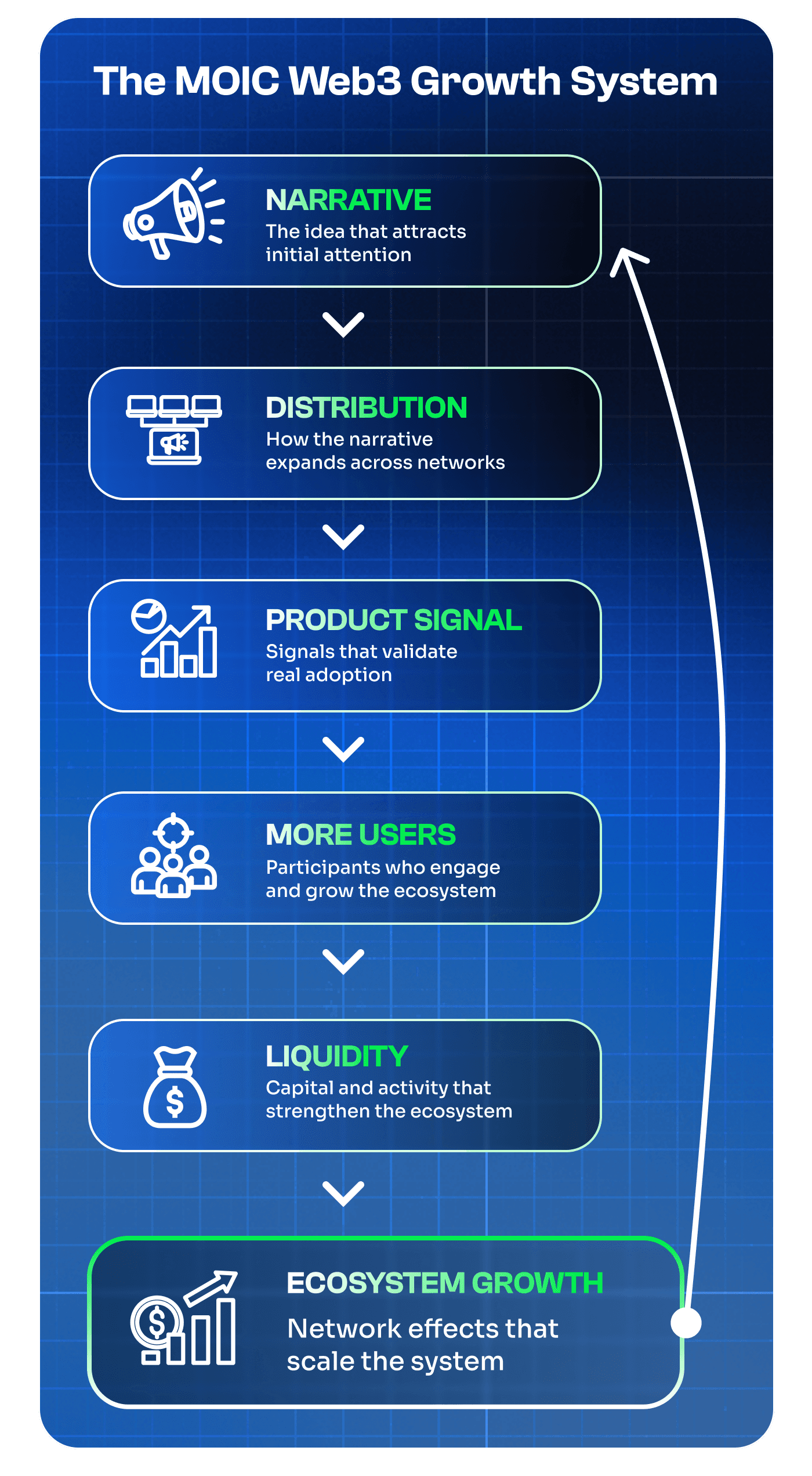
In decentralized ecosystems, growth typically follows a structured progression rather than traditional advertising funnels.
At MOIC, we describe this dynamic as The Web3 Growth System:
Narrative → Distribution → Product Signal → Users → Liquidity → Ecosystem Growth
The process begins with a compelling narrative that spreads through distribution networks.
As users begin interacting with the protocol, product signals emerge, attracting additional participation.
Over time, user activity generates liquidity, which strengthens the ecosystem and creates a self-reinforcing growth loop.
In decentralized ecosystems, growth typically follows a structured progression rather than traditional advertising funnels.
At MOIC, we describe this dynamic as The Web3 Growth System:
Narrative → Distribution → Product Signal → Users → Liquidity → Ecosystem Growth
The process begins with a compelling narrative that spreads through distribution networks.
As users begin interacting with the protocol, product signals emerge, attracting additional participation.
Over time, user activity generates liquidity, which strengthens the ecosystem and creates a self-reinforcing growth loop.
The Web3 Hype Trap
The Web3 Hype Trap
One of the most common failure patterns in Web3 marketing is confusing attention with adoption.
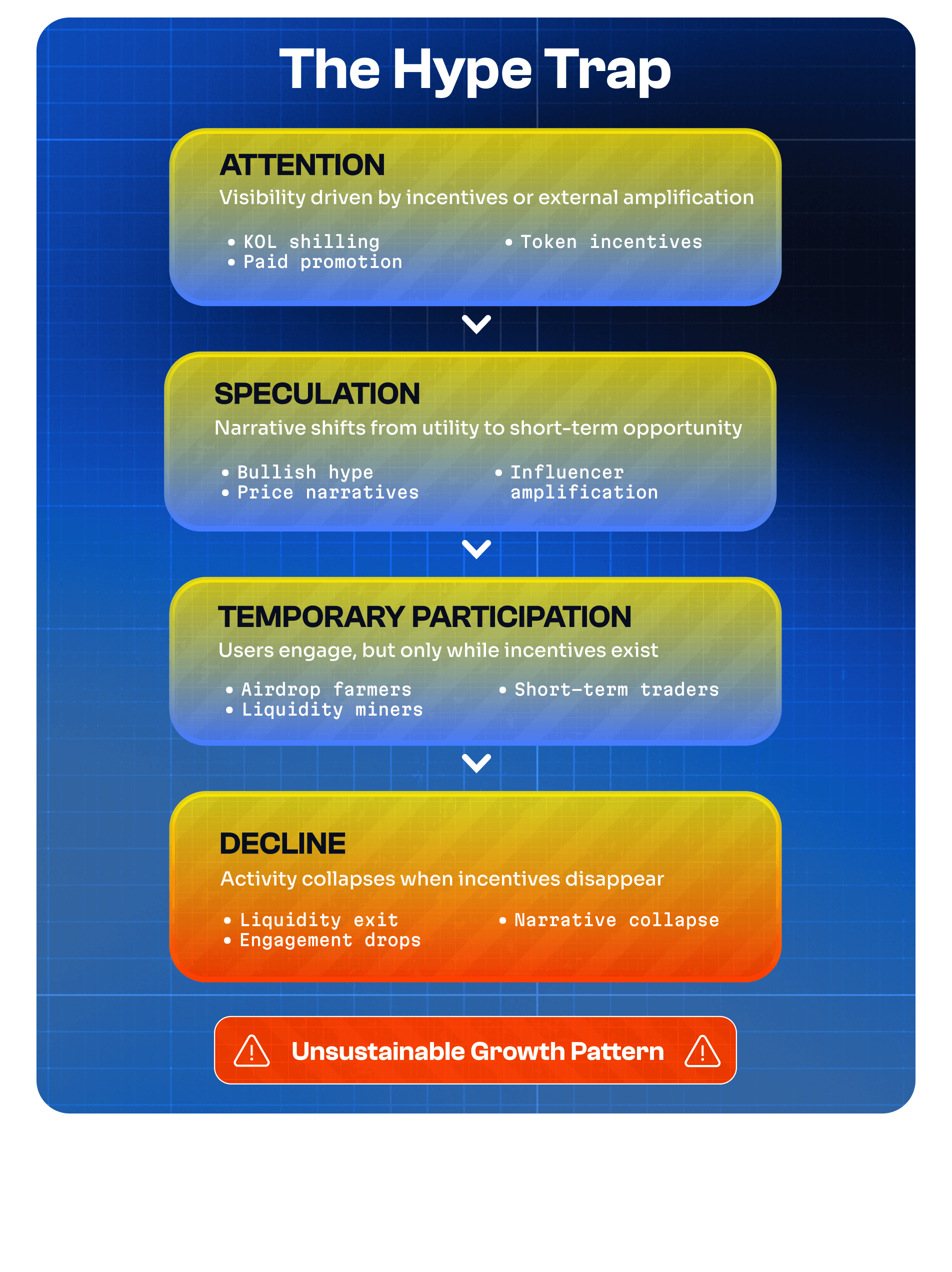
Many projects rely on short-term tactics such as:
influencer promotion
token incentives
speculative hype
These activities often generate rapid visibility but rarely produce durable ecosystems.
Projects caught in this pattern follow a predictable sequence:
Attention → Speculation → Temporary Participation → Decline
Without strong product signals and genuine community engagement, participation fades once incentives disappear.
One of the most common failure patterns in Web3 marketing is confusing attention with adoption.
Many projects rely on short-term tactics such as:
influencer promotion
token incentives
speculative hype
These activities often generate rapid visibility but rarely produce durable ecosystems.
Projects caught in this pattern follow a predictable sequence:
Attention → Speculation → Temporary Participation → Decline
Without strong product signals and genuine community engagement, participation fades once incentives disappear.
The Organic-First Principle
The Organic-First Principle
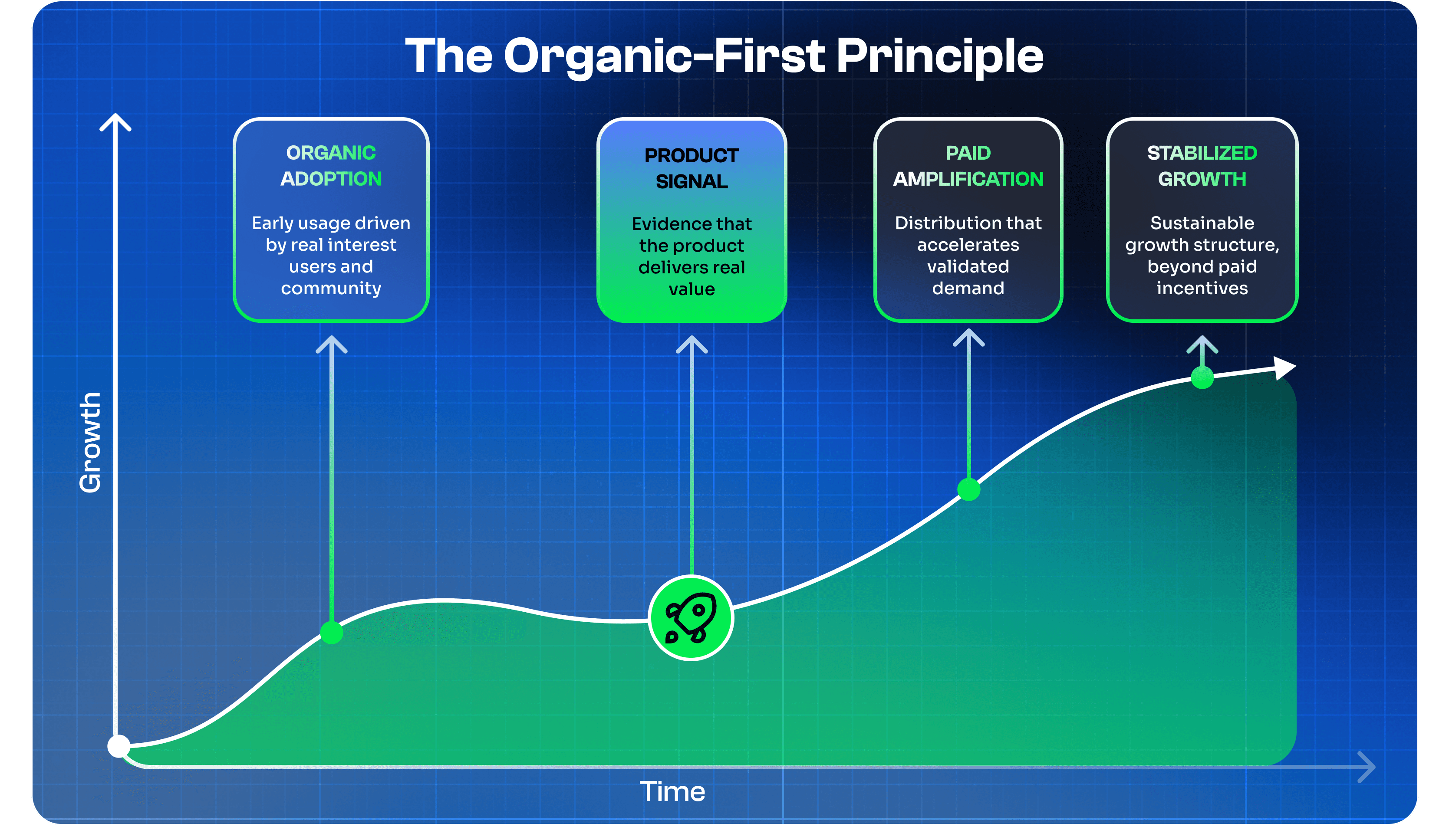
Successful Web3 Ecosystems typically grow through a specific sequence.
Organic participation appears before large-scale paid marketing.
Early signals such as:
developer adoption
community engagement
liquidity participation
Those are important signals that the protocol delivers real value.
Only after these signals emerge does paid distribution act as amplification, accelerating growth rather than attempting to manufacture demand.
In Web3, marketing works best when it amplifies the signal rather than creating it.
Successful Web3 Ecosystems typically grow through a specific sequence.
Organic participation appears before large-scale paid marketing.
Early signals such as:
developer adoption
community engagement
liquidity participation
Those are important signals that the protocol delivers real value.
Only after these signals emerge does paid distribution act as amplification, accelerating growth rather than attempting to manufacture demand.
In Web3, marketing works best when it amplifies the signal rather than creating it.
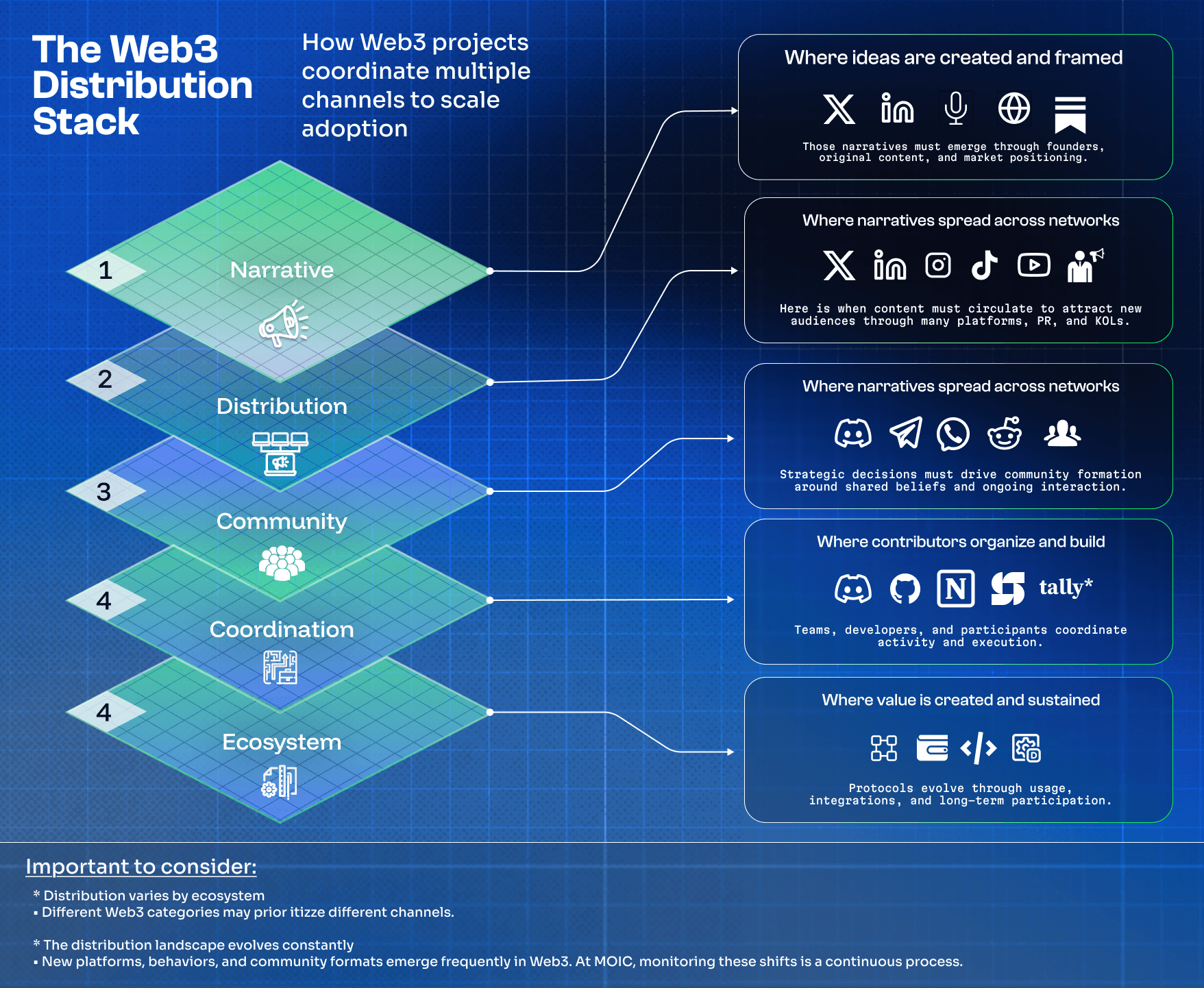
The Web3 Distribution Stack
The Web3 Distribution Stack
Web3 ecosystems rely on open communication networks rather than traditional advertising infrastructure.
These networks form what we call the Web3 Distribution Stack.
Different platforms perform different roles within the ecosystem:
X (Twitter) often functions as the narrative layer where ideas spread rapidly.
Discord operates as a coordination layer for communities and contributors.
Telegram acts as a real-time communication layer, particularly in trading and DeFi environments.
However, distribution stacks vary by project type.
For example:
Crypto neobanks may gain traction on Instagram
Trading communities often prefer Telegram
Decentralized protocols frequently organize discussion through DAO forums
Effective Web3 marketing aligns narrative, community behavior, and communication infrastructure.
Web3 ecosystems rely on open communication networks rather than traditional advertising infrastructure.
These networks form what we call the Web3 Distribution Stack.
Different platforms perform different roles within the ecosystem:
X (Twitter) often functions as the narrative layer where ideas spread rapidly.
Discord operates as a coordination layer for communities and contributors.
Telegram acts as a real-time communication layer, particularly in trading and DeFi environments.
However, distribution stacks vary by project type.
For example:
Crypto neobanks may gain traction on Instagram
Trading communities often prefer Telegram
Decentralized protocols frequently organize discussion through DAO forums
Effective Web3 marketing aligns narrative, community behavior, and communication infrastructure.
From Marketing Campaigns to Ecosystem Systems
A central insight of the MOIC Canon is that Web3 growth emerges from systems rather than campaigns.
Traditional marketing focuses on short-term attention.
Decentralized ecosystems grow through the interaction between:
Narrative construction
Community distribution
Product participation
Liquidity generation
When these elements reinforce each other, ecosystems develop the capacity to scale organically.
From Marketing Campaigns to Ecosystem Systems
A central insight of the MOIC Canon is that Web3 growth emerges from systems rather than campaigns.
Traditional marketing focuses on short-term attention.
Decentralized ecosystems grow through the interaction between:
Narrative construction
Community distribution
Product participation
Liquidity generation
When these elements reinforce each other, ecosystems develop the capacity to scale organically.
The MOIC Research Agenda
The frameworks presented in the MOIC Web3 Marketing Canon represent the foundation of our research into how decentralized ecosystems grow.
As Web3 continues to evolve, MOIC will expand this Canon with new frameworks and insights designed to explain the dynamics of digital network adoption better.
The MOIC Research Agenda
The frameworks presented in the MOIC Web3 Marketing Canon represent the foundation of our research into how decentralized ecosystems grow.
As Web3 continues to evolve, MOIC will expand this Canon with new frameworks and insights designed to explain the dynamics of digital network adoption better.


Where intelligence becomes real influence

@ 2026 - Moic Digital
Where intelligence becomes real influence
@ 2026 - Moic Digital