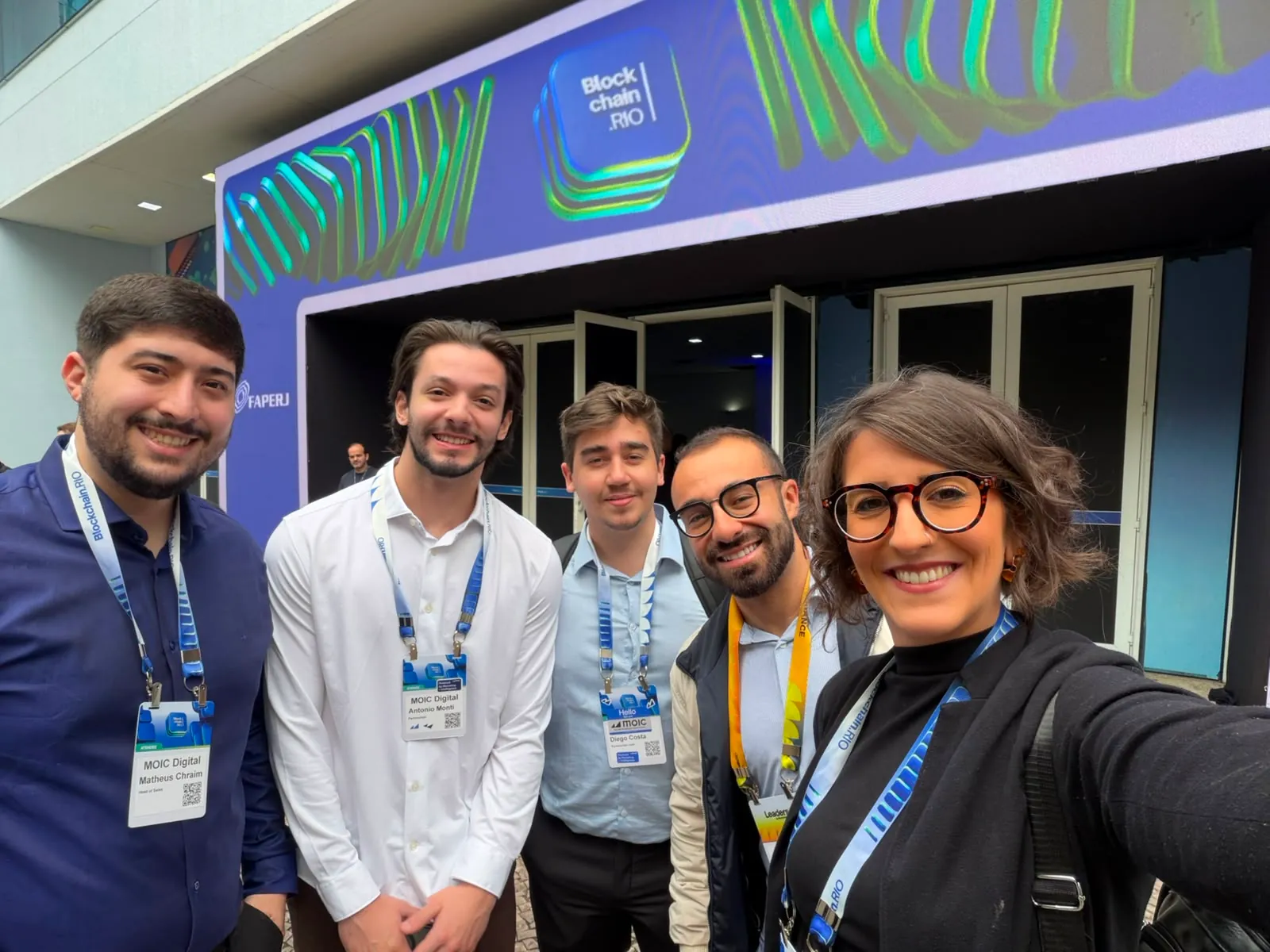
On August 11 to 13, 2026, Blockchain.RIO brought together financial institutions, regulators, technology companies and digital infrastructure leaders to discuss the next phase of the digital asset market. The program was organized across different tracks, including Global Finance, StableCon, AI Builders, Regulation Rocks, LFDT, among others.
Despite the variety of topics, five themes appeared repeatedly and help explain where the industry is heading.
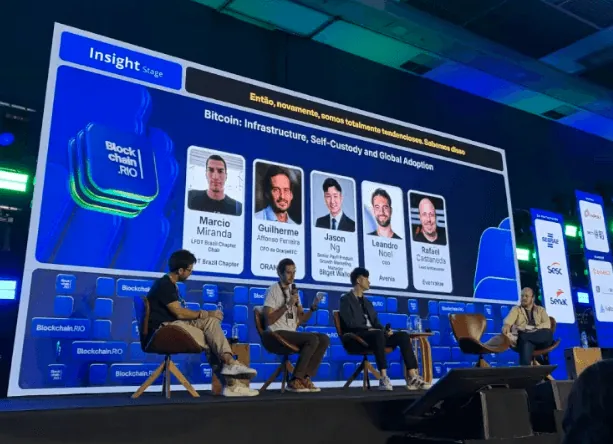
More than discussing the distant future of blockchain, the event showed a shift in the market’s agenda: the industry is increasingly focused on how to turn on-chain technology into financial infrastructure used by companies, institutions and consumers.
The event’s own corridors reinforced this shift. Banks such as Bradesco , BTG Pactual and Itaú Unibanco were in the same environment as infrastructure companies such as Fireblocks and Chainlink Labs , payment players such as Visa , Ripple , Tether.io and RedotPay , as well as security, technology and market infrastructure companies such as CertiK , Amazon Web Services (AWS) , Alpaca and Ondo Finance.
The overall tone was one of building an institutional layer for the digital financial system, with an emphasis on interoperability, compliance, security and scalability.
1. Financial infrastructure took center stage
One of the strongest signals from the event was how much attention was given to the infrastructure underneath blockchain applications.
On August 11, before the main conference, the Financial Infrastructure Forum LATAM brought together financial institutions, regulators and infrastructure providers to discuss how money could move across Latin America and other markets.
The conversation focused on tokenization, stablecoins, global payments, settlement and interoperability. Those themes continued throughout Blockchain.RIO on August 12 and 13.
The infrastructure required for institutional adoption goes far beyond smart contracts. It includes custody, settlement, identity, compliance, interoperability, connectivity between systems and integration with traditional financial institutions.
The presence of companies such as Fireblocks and CertiK made this particularly visible. Jorge Borges , Head of Latam at Fireblocks, participated in discussions around the infrastructure institutions need to operate digital assets securely. Jason Jiang , Chief Business Officer at CertiK, brought the perspective of security and protection of blockchain infrastructure.
This is an important shift in the market.
Security, compliance and risk management are no longer simply additional services around blockchain products. They are becoming part of the infrastructure required to put those products into production. The same applies to interoperability, tokenized assets and stablecoins will not operate at scale if different networks, institutions and legacy systems cannot exchange information and settle transactions reliably.
For a financial institution, moving an asset on-chain therefore means solving a much larger operational problem. Legacy systems need to connect to new infrastructure. Controls need to be established. Regulatory requirements need to be met. Operational risks need to be managed.
This less visible layer may become one of the biggest commercial opportunities of the next phase of the market. As banks, asset managers, fintechs and payment companies move forward with their on-chain initiatives, they will need infrastructure that connects new digital rails with the financial systems they already depend on.
2. Tokenization is advancing into capital markets
Tokenization was one of the most recurring topics at the event, particularly in discussions around Real-World Assets, funds, credit and capital markets.
But the conversation has clearly moved beyond the idea of simply turning an asset into a token. The more important questions are now what happens after the asset is represented digitally: how it is issued, traded, settled, custodied, regulated and integrated into the financial systems that institutions already use.
Binance , for example, led discussions around how digital assets can connect with conventional financial markets through tokenization and institutional distribution. Ondo Finance brought a perspective focused on tokenized asset infrastructure and institutional DeFi, while Alpaca showcased infrastructure connecting traditional markets and digital assets through brokerage and APIs.
Atlas, another player present at the event, positioned itself around infrastructure for private markets, combining AI, tokenization and investment infrastructure. Together, these examples point to a broader change in how tokenization is being understood. The value proposition is increasingly connected to market efficiency: more automated issuance and settlement, broader distribution and new ways to access and trade assets.
But this also introduces infrastructure questions. Who controls the rails? How do different networks communicate? How are legal rights associated with an asset represented on-chain? How do institutions integrate tokenized assets into compliance, accounting and risk management?
That is why tokenization is becoming part of a much larger conversation about the future of financial markets. The next challenge is moving from institutional pilots and proof of concepts to products that can operate reliably and at scale.
3. Stablecoins are taking root the conversation about money
At Blockchain.RIO, the conversation focused on their potential role in moving and settling value between institutions, markets and countries, rather than simply treating them as crypto assets.
The presence of Tether, Ripple, Visa and RedotPay reflected this evolution. Tether participated from an institutional stablecoin perspective, while Ripple brought its focus on payments and cross-border value movement. Visa’s presence showed how traditional payment companies are incorporating digital assets into their view of the future of money. RedotPay added another perspective focused on payment infrastructure connecting digital assets with financial operations.
For companies operating across borders, the proposition is particularly relevant. Blockchain-based rails can potentially change how value moves internationally, creating new possibilities around speed, availability and transaction costs.
But the infrastructure required to make that happen is considerably more complex than simply issuing a stablecoin, there are questions around reserves, compliance, conversion into local currencies, settlement and integration with existing financial systems. For stablecoins to function as settlement infrastructure at scale, the surrounding ecosystem needs to make their movement predictable and reliable.
That is also where regulation becomes increasingly important. The closer stablecoins get to functions traditionally performed by banks and payment networks, the more important questions around controls, responsibilities and regulatory frameworks become.
The signal from Blockchain.RIO was clear: stablecoins are increasingly being evaluated for what they can enable within the financial system, not just for how they perform inside the crypto market.
4. Regulation has become part of product development
Regulation appeared throughout Blockchain.RIO, particularly in Regulation Rocks and discussions involving CVM, DREX and regulatory sandboxes.
What stood out was not simply the presence of regulators, but how closely regulation was connected to the development of actual financial products. The presence of CVM, Banco Central, B3 and banks such as Bradesco and Itaú reinforced this convergence between regulation, infrastructure and the financial market.
The regulatory conversation is also becoming more participatory. Juntos por Cripto , one of the event sponsors, had 🏳️🌈 Marina Fuzeti Fagali , its director, participating as a speaker. This shows that the market itself is becoming more involved in the construction of the rules that will shape the development of digital assets in Brazil.
This matters because regulation is increasingly becoming part of the product architecture, on-chain products introduce concepts that are still unfamiliar to many users of traditional financial services: wallets, seeds, self-custody, key management and direct responsibility for assets.
Greater user autonomy can also mean greater operational responsibility. For institutions, this creates an opportunity to provide regulated access points for users who are not prepared to manage the full complexity of self-custody.
The broader challenge is trust. For on-chain products to reach a larger market, technology alone will not be enough. Institutions and users need clear rules, defined responsibilities and predictable mechanisms for managing risk. That makes regulation increasingly relevant not only to whether a product can exist, but to how the product itself is designed.

The future is made of freedom
5. From copilots to agents: AI is starting to operate on-chain
AI was another major theme, but the interesting part was the direction of the conversation.
AI Frontiers, curated by Cultura Builder, focused on practical applications of AI, automation and intelligent agents. The discussion moved beyond traditional copilots that help people research, write or analyze information.
The focus shifted toward systems that can execute tasks, make decisions within defined parameters and interact directly with digital infrastructure, this brings AI closer to what is increasingly being described as agentic finance. In practice, an agent could monitor market conditions, execute a strategy, rebalance a portfolio, make a payment or interact with a smart contract without requiring human approval at every stage.
That creates a fundamentally different set of questions. If software can move money or digital assets, what is it authorized to do? Under which conditions? Who is responsible for its actions? And how can those actions be verified?
This is where AI and blockchain begin to converge.
AI can provide intelligence, decision-making and execution. Blockchain can provide part of the infrastructure required to establish permissions, enforce limits and create a traceable record of operations.
The connection is already beginning to appear in financial markets. ANBIMA, for example, has been developing AI applications for fund self-regulation, including a chatbot designed to provide fast and secure answers, support compliance analysis and reduce risks.
The broader lesson is that AI adoption in financial services will require more than increasingly capable models. It will require infrastructure that connects intelligence, rules and execution. We are still far from a financial system fully operated by autonomous agents. But the conversation is already changing from “how can we use AI?” to a more strategic question:
What happens when software starts operating directly on financial infrastructure?
What these five themes have in common
Tokenization, stablecoins, infrastructure, regulation and AI may look like separate conversations. At Blockchain.RIO, however, they increasingly appeared as different layers of the same transition.
Tokenization creates new ways to represent and move assets, stablecoins create new rails for transferring and settling value, infrastructure connects those new systems to existing financial institutions and regulation creates the conditions for products to operate with greater predictability.
And AI introduces a new layer of automation that could change how people and companies interact with financial infrastructure, the important point is that these layers are beginning to converge. The market is moving toward a financial architecture in which assets, money, institutions and software agents can interact within increasingly connected systems.
That changes the opportunity for B2B companies…
Building the technology is still necessary, but the next phase will increasingly depend on solving concrete problems across the financial stack: settlement, custody, compliance, payments, distribution, interoperability and automation.
This was perhaps the clearest signal from Blockchain.RIO 2026. The market is building new rails for money, new formats for assets and new ways of operating financial infrastructure and the next competition will be about turning that infrastructure into products that institutions can actually integrate, operate and scale.
See you next year, Blockchain.Rio 🌊