#3 - The organic content strategy to win on Social Media

Contributor
By Matheus Melo, Marketing Strategist at MOIC
Working with dozens of global companies, especially in Onchain Finance, we realized something: your audience isn't looking for generic content, they're looking for answers. Some want to understand what's changing in the market, others are evaluating different ways to solve a problem or comparing vendors before making a decision, some are already customers looking to get more value from your product, while others simply want to connect with people facing the same challenges.
Every person is trying to answer a different question, and your content should reflect that.
The big challenge here is delivering those answers consistently, without a clear content framework, most brands end up publishing generic content, repeating the same topics, or struggling to decide what to post next.
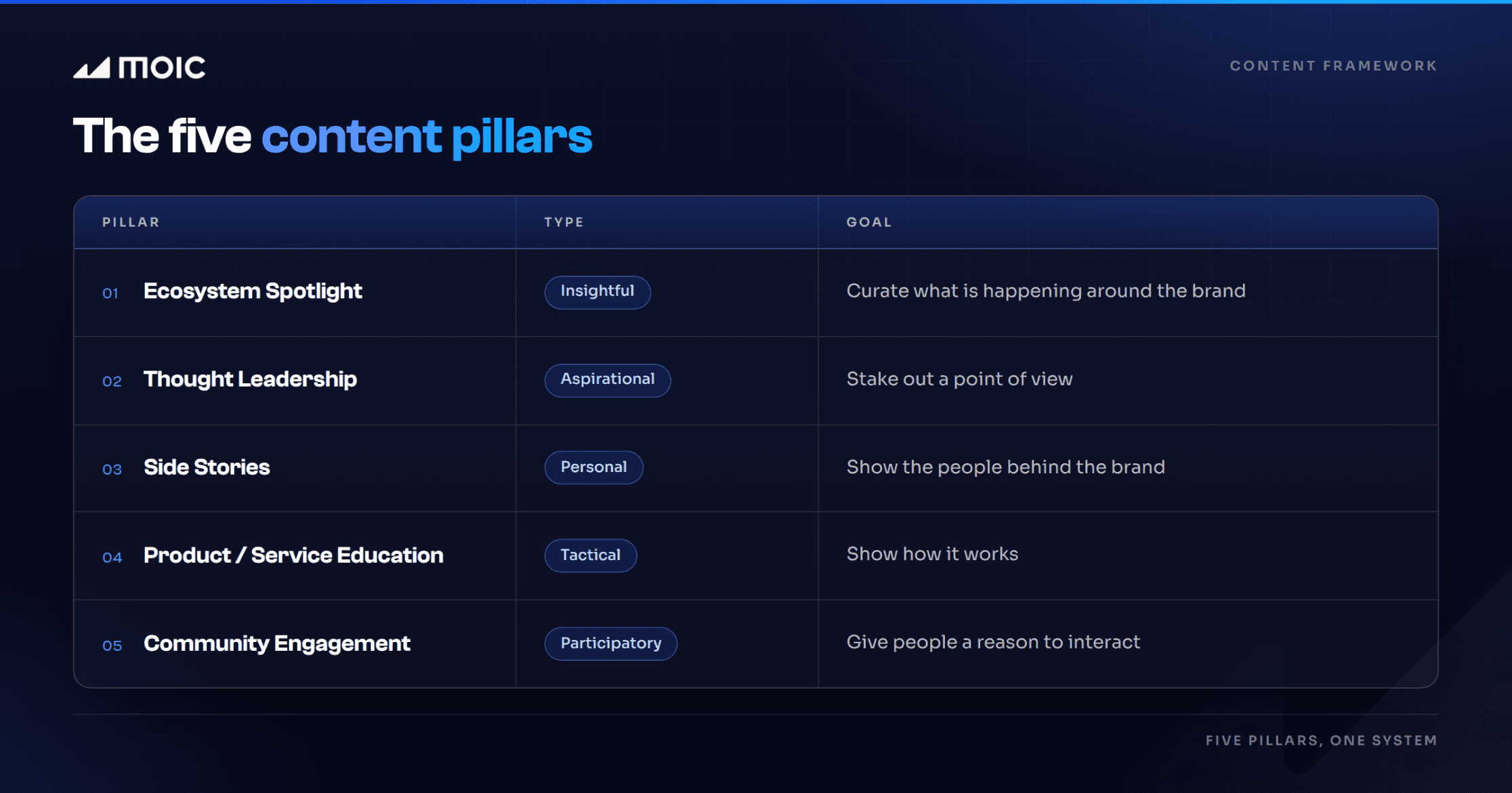
That's why we developed the Five Pillars Framework here at MOIC, a methodology we use to build content strategies for our clients. Instead of publishing just to stay active, the framework helps create content with a clear purpose, each pillar addresses a different audience need and supports a different stage of the customer journey. Together, they create a balanced content strategy that builds awareness, trust, product understanding, and community over time.
Today, we're sharing that framework with you.
The journey to a customer who recommends you
Ask what an audience needs from a brand it follows and the list turns out to be short.
It has come back the same for us across DeFi protocols, cross-border payments, and futures trading, which are audiences with little else in common.
Follow one person through it: first they want to be informed, because the right decision rests on understanding what is happening in the space, then comes the harder question of how to actually solve the problem, and that's when they start looking for a product that could help.
They find several companies offering similar solutions, but they choose the brand they identify with most, which means the brand has to show what it believes, where it thinks the category is going, and why it built the product in the first place.
That leads to the next question: who is behind this company? They look for the founder, the team, and the people building the product, all before they make a purchase.
Then they become customers, and now what? Documentation is rarely enough. New features ship, new use cases emerge, and there are always opportunities customers haven't discovered yet, so they need ongoing education to get the most value from the product before a competitor starts looking easier.
And once they love it, they recommend it, because if it worked for them, it can work for someone else, and that's where community begins. Five different needs, moments in the customer journey, and each one is answered by one of the five content pillars.
The 5 Content Pillars
1. Ecosystem Spotlight: the insightful pillar, focused on what's happening around the market. It serves readers who are still trying to understand the category and make sense of what's changing through industry news, partner announcements, market reactions, research, event recaps, and curated insights from trusted third parties. The story should always be driven by what matters to your audience, not by what your brand wants to promote. The goal: become a trusted source by consistently curating what matters.
2. Thought Leadership: the aspirational pillar, focused on why it matters. It speaks to people evaluating different solutions and looking beyond feature comparisons by sharing frameworks, market analysis, predictions, contrarian opinions, and the founder's perspective on where the industry is heading. The goal: build authority by shaping how people think about the market rather than simply promoting your product.
3. Side Stories. The personal pillar, focused on who is behind the company. Once people believe in your ideas, they naturally want to know the people building them, which makes behind-the-scenes moments, lessons learned, milestones, challenges, and stories from the team some of the most valuable content a brand can publish. The goal: build trust by putting real people behind the brand.
4. Product / Service Education. The tactical pillar, focused on how it works. It serves existing customers and prospects who need practical guidance beyond the documentation through tutorials, onboarding content, feature breakdowns, use cases, FAQs, and implementation tips that help them get more value from the product over time. The goal: turn interest into understanding while reducing friction throughout the customer journey.
5. Community Engagement. The participatory pillar, focused on bringing people into the conversation. It creates moments your audience immediately relates to through memes, polls, questions, shared experiences, customer spotlights, and conversations that encourage interaction. Even highly technical B2B brands should make room for this type of content because people engage with brands they feel connected to. The goal: create a sense of belonging and give people a reason to participate, engage, and eventually advocate for your brand.
How to get five posts out of one idea
The five pillars aren't just a way to organize your content, but a way to multiply it.
Take a single subject, for example, a risk-rating model your team has just rebuilt, instead of publishing one announcement and moving on, you can approach the same topic from five different angles, each written for a different stage of the customer journey.
Ecosystem Spotlight: The three biggest mispricings the category saw this quarter and what caused each one. Reaches the person still trying to understand the market.
Thought Leadership: Why the standard way of scoring risk in this category is broken and what should replace it. Reaches the person comparing your company with other vendors.
Side Stories: Who on the team built the model, where they first encountered this problem, and why they decided to solve it. Reaches the person deciding whether your team is worth trusting.
Product Education: How the model works in practice and what each rating actually means. Reaches the customer who wants to get more value from the product.
Community Engagement: What it actually feels like to size a position without a risk score you trust. Everyone in the industry has experienced that moment. Reaches the person who immediately recognizes themselves in the story.
One subject can generate five completely different conversations because each pillar serves a different purpose and speaks to a different audience need. Instead of creating a single post and moving on, your team builds a connected content system where every piece reinforces the others while moving the customer further along their journey.
That's when the blank page stops being a problem. Instead of asking, "What should we post today?", the question becomes, "Which pillar should we focus on, and what knowledge or insight do we already have that fits it?".
Why not just follow the good metrics?
A common question is: if one type of content consistently performs well, why not just publish more of it?
You should absolutely replicate what works, but you need to do it strategically.
Success isn't about repeating the same format or topic over and over, but understanding why a post performed well and applying those learnings across your content strategy. Otherwise, your feed becomes repetitive, your audience sees less variety, and you eventually stop reaching people with different needs.
Your audience isn't made up of people at the same stage of the journey, the post that generates the most likes or comments usually resonates with one specific segment of your audience, and if you only optimize for that, you gradually stop creating content for everyone else.
Not every post has the same job, some introduce people to your category, others build authority, create trust, educate customers, or strengthen your community, looking only at engagement metrics makes it easy to overinvest in one pillar while neglecting the others.
The Five Pillars Framework helps you strike that balance, allows you to double down on what works while ensuring you're still creating content for every stage of the customer journey. Over time, this builds a stronger content ecosystem where every post has a purpose instead of simply chasing the next viral result.
A dashboard can tell you what performed yesterday but a strategy tells you what to publish next.
Why you should implement this framework today
The biggest advantage of the Five Pillars Framework is that it helps your brand stay relevant throughout the entire customer journey. Instead of creating content for just one audience segment, you create content for people discovering the category, evaluating solutions, building trust in your company, learning how to use your product, and eventually recommending it to others.
That's what a content strategy should do. It shouldn't just fill a content calendar, it should answer questions before prospects ask them, build credibility before sales conversations begin, educate customers after they buy, and create opportunities for your community to engage with your brand.
The result is a content engine that consistently builds awareness, trust, product adoption, and advocacy, instead of only chasing reach or engagement.
That's the framework we use at MOIC to build content strategies for our clients. If you want to map the Five Pillars to your product, your market, and your audience, we'd be happy to help!


