#2 - Why we built an Intelligence squad (and what it has to do with Onchain Finance)

Contributor

A few months ago, as soon as I landed in New York for a series of meetings with clients and partners, a billboard caught my attention. The message was short, but powerful: "Data smarter, not faster". I kept thinking about it for several days because, to me, it validated the direction we had already been building at MOIC. It perfectly captured what we had been discussing internally: executing faster is no longer enough if you don't know where you're going, which opportunities truly matter, or who needs to be influenced for a strategy to succeed.
For years, the market believed that competitive advantage meant being first: the first to launch a product, publish an insight, respond to a regulatory change, comment on a trend, release a report, or own a narrative before everyone else. Speed was a scarce resource and, precisely because of that, it created differentiation, but AI and automation have changed that dynamic.
The real competitive advantage is no longer speed itself, but the ability to transform data into intelligence.
The true meaning of marketing intelligence
This shift led us to an inevitable question: what does marketing actually mean in a market as complex as Onchain Finance?
The answer begins with understanding that, in Onchain Finance, attention alone is not enough to generate business. Unlike many other industries, we are dealing with long enterprise sales cycles, regulatory requirements, complex integrations, and a high level of trust between counterparties. In this environment, closing a deal depends far more on the quality of relationships and market understanding than on the ability to generate reach.
That's why the role of marketing also changes. Its objective is no longer simply to generate demand, but to create the conditions for business opportunities to happen, that means strengthening positioning, building credibility, developing strategic relationships, and supporting sales with market intelligence.
In this context, Marketing Intelligence stops being a support function and becomes a strategic capability. Not to produce more dashboards or track vanity metrics, but to understand how a market truly works. Who influences decisions? Which companies are accelerating? Which narratives are gaining momentum? Where are new opportunities emerging? And which signals indicate a market shift before it becomes obvious to everyone else.
Answering these questions allows marketing and business development teams to move from reactive execution to informed decision-making, focusing their efforts on the accounts, relationships, and opportunities with the greatest potential to generate results.
The problem
When you talk to everyone, you talk to no one
Decision-makers don’t buy from strangers, the most important decisions begin long before they enter a CRM, through conversations between clients, investors, regulators, founders, and partners where influence is built, buying committees take shape, and the signals that truly matter first emerge.
The problem is that most marketing and sales teams are operating with only a fraction of that reality. They see the contacts they already know, the accounts already in their pipeline, and the conversations happening directly around them. What they don’t see is the broader network shaping those opportunities: the introductions that will happen tomorrow, the trusted referrals between executives, the informal conversations at industry events, or the relationships that quietly influence enterprise buying decisions before any opportunity becomes visible.
Every high-value deal is decided inside a network you can’t fully see.
Committees form behind closed doors, referrals often outweigh the best sales pitch, and the warmest path to your next customer frequently already exists through people your team isn’t tracking. In other words, marketing and sales are making strategic decisions while looking at only a small slice of the market.
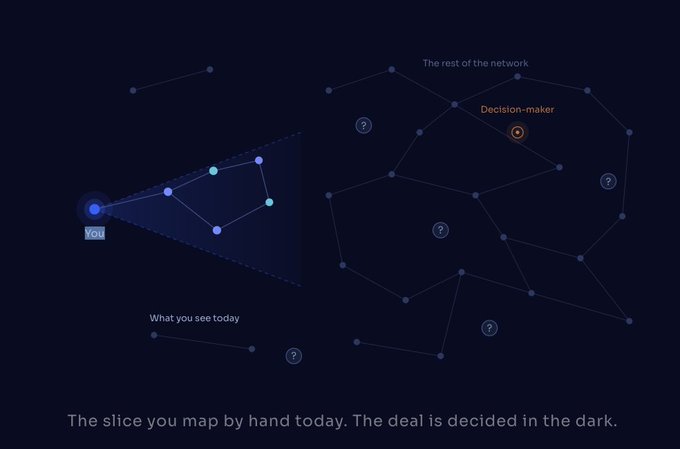
At MOIC, we believe the challenge isn’t a lack of data. Most of these signals already exist, and many of them are publicly available, the challenge is connecting them to reveal patterns, relationships, and opportunities that would otherwise remain invisible. Instead of looking only at companies, we map the relationships between founders, executives, investors, partners, clients, regulators, communities, and the narratives connecting them, that is where intelligence begins.
In Onchain Finance, authority is not built by speaking to everyone, but by understanding who influences everyone else. The deeper your understanding of those networks becomes, the greater your ability to build strategic relationships, establish credibility, prioritize the right opportunities, and make better marketing and sales decisions before the rest of the market reaches the same conclusion.
Building the Intelligence Squad
Through this context, we decided to build an Intelligence Squad at MOIC.
We had already been using AI across different internal processes, but we realized that its greatest potential was not automation or productivity gains. Its real value lies in expanding our analytical capabilities, allowing us to connect thousands of fragmented signals, identify patterns, and turn them into competitive advantage.
Every day, the market generates an enormous volume of signals: company movements, regulatory changes, funding rounds, research, events, product launches, new hires, acquisitions, and new products. But there are also much more subtle signals, such as shifts in narratives, communication patterns, executive relationships, connections between companies, emerging influence networks, leadership behavior, community interactions, competitor movements, public positioning, and the timing behind all of these developments.
Individually, these signals say very little, and many of them are publicly available, but their real value lies in connecting them to reveal patterns, relationships, and opportunities that would otherwise remain invisible.
That led us to a simple question: if AI makes execution cheap, what becomes expensive?
Our conclusion was that intelligence becomes the scarce resource. Not information, since everyone has access to it, or execution, since AI continues to reduce its cost, but what becomes increasingly valuable is the ability to understand which signals matter, how they relate to one another, and what they reveal before the rest of the market reaches the same conclusion
That depth of intelligence cannot be achieved simply by asking Claude, ChatGPT, or any other AI model a question. It requires an infrastructure designed to continuously collect, connect, prioritize, and interpret market signals at scale.
Our Intelligence Squad is built on three core pillars:
Proprietary algorithms, designed to map, connect, and prioritize market signals, transforming massive volumes of information into relevant opportunities.
Proprietary intelligence, built from the data, analyses, learnings, and patterns accumulated across hundreds of projects and continuously refined with every new interaction.
Specialized human intelligence, responsible for interpreting those signals, validating hypotheses, and transforming information into strategic direction for marketing, sales, and business development.
The combination of these three elements makes the system smarter with every iteration. Algorithms organize the data, proprietary intelligence accumulates market context, and our team's expertise transforms that knowledge into decisions tailored to each business.
The outcome goes far beyond traditional market research or AI-generated content, we are able to answer questions that would normally require weeks of investigation: which companies have the greatest potential, which markets are accelerating, who truly influences a decision, which executives are worth building relationships with, which narratives are gaining momentum, and where it is worth investing time and resources before those opportunities become obvious to the rest of the market.
Turning intelligence into business
Like any new initiative, the true impact of our Intelligence Squad will become clearer over the coming months as we continue validating our models, refining our methodology, and expanding its capabilities. What we’ve seen so far, however, reinforces our belief that market intelligence will become a core capability for companies operating in Onchain Finance.
Understanding how relationships are formed, who influences decisions, and where opportunities emerge allows companies to allocate their time and resources far more effectively. Instead of relying on intuition alone, marketing, sales, and business development teams can prioritize the right accounts, engage stakeholders at the right moment, and build relationships that are far more likely to convert into long-term business.
The obvious next question is: How do you actually build an intelligence system capable of mapping relationships, identifying opportunities, and supporting strategic decisions in Onchain Finance?
That’s exactly what we’ll cover in our nexts editions, where we’ll take you behind the scenes of the infrastructure we’ve built, the data sources we combine, and the methodology that transforms thousands of market signals into actionable intelligence.
If you're building in onchain finance and believe market intelligence can become a competitive advantage for your business, let's talk. We'd be happy to show you how we're applying this approach to help your company build strategic relationships, identify opportunities, and accelerate deals with data.


