Why Publishing in English Gets You Found, Even When the Question Isn't in English

MOICMOIC Digital
5 min read
If a rule changes in Portuguese, Spanish or any other language, the fastest way to be the brand AI search cites about it may be to explain it in English. In the view of MOIC Digital, an English explainer of a local-language change is one of the cheapest openings in AI search right now, and very few companies take it.
There are two reasons. The first is our reading of the research: AI search tools often run part of their searches in English, even when the user writes in another language, so an English page can surface for questions that were never asked in English. The second we saw directly: people who ask in English get answers built from English pages, and when the English web has not caught up with a local change, they get the old version.
Two ways an English page gets found
1. AI search often searches in English, whatever the prompt language. ChatGPT search rewrites a prompt into one or more queries and can send follow-up queries after the first results come back (OpenAI). Google says AI Mode and AI Overviews run several related searches across subtopics to build an answer, a technique it calls query fan-out (Google). Neither company says in what language those queries run.
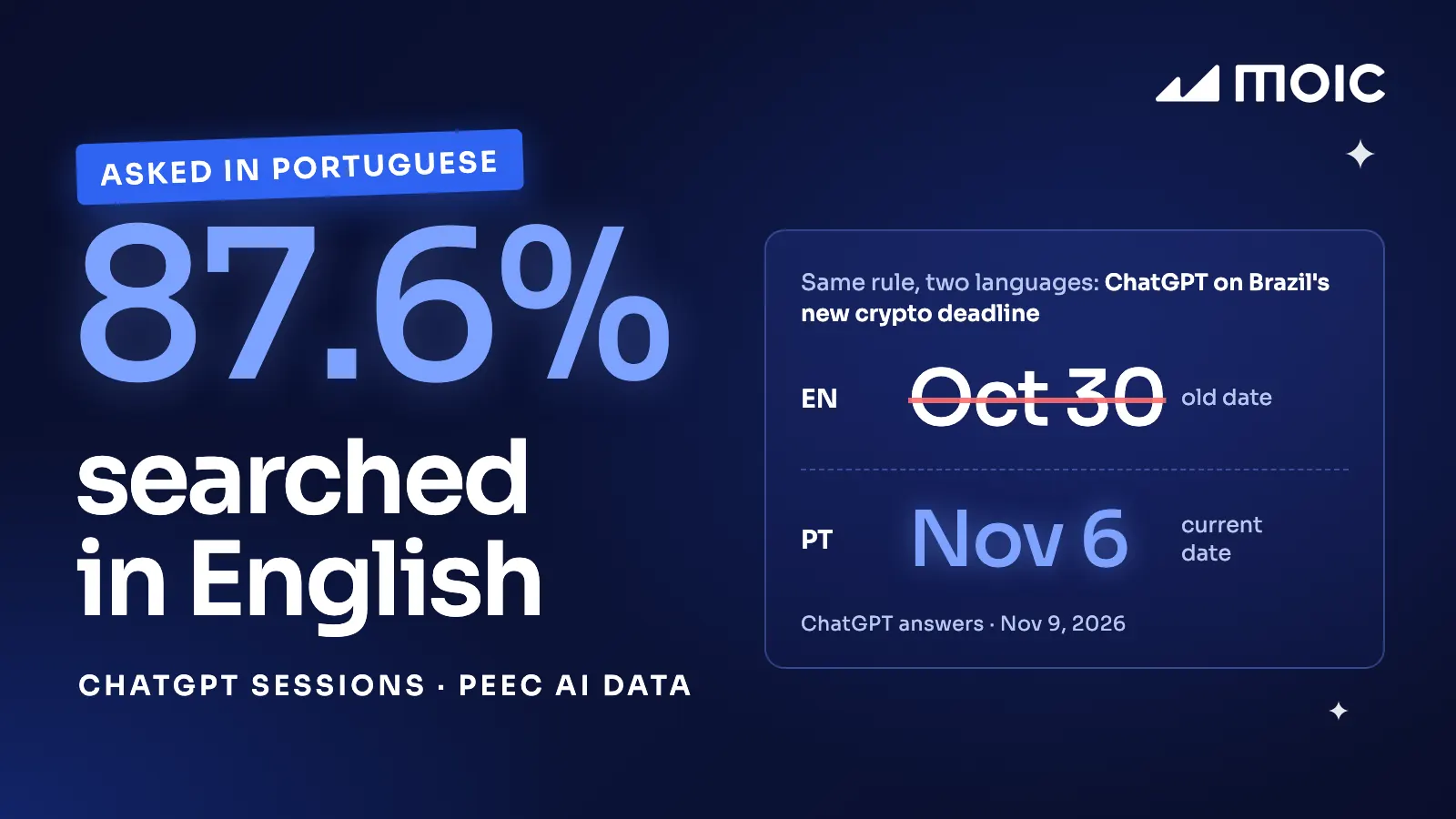
Outside data says that, for ChatGPT, it is often English. Peec AI analyzed more than 10 million prompts and 20 million fan-out queries and found that 43% of the fan-outs for non-English prompts were in English. For prompts in Portuguese, 87.6% of sessions included at least one English search; for Spanish, the lowest language in the study, 66.7% (Peec AI). A separate study of about 7 million citations found that English pages made up 23.7% of ChatGPT’s citations for prompts in six European languages, against 8.7% for Google AI Overviews (Temso).
The evidence has limits. Both studies come from vendors that sell AI visibility tools. The Temso study did not include Portuguese, and we found no published measurement of fan-out language for Gemini, AI Mode or Perplexity. Lab work adds a caution: in controlled tests of retrieval-augmented models, models asked in English favored English sources, and models asked in another language favored sources in that language (Ki et al., 2025).
So this first reason is our hypothesis, backed by vendor data for ChatGPT and weaker for Google: an English page gives you a second chance to be cited on questions asked in other languages.
2. People who ask in English get English sources. This one needs no hypothesis. A compliance lead at a US or Canadian fintech asking about Brazil will ask in English, and the engine will build the answer mostly from English pages. If those pages are out of date, the answer is too. We watched that happen.
The proof: one rule, two languages, two answers
On November 9, 2026, we asked ChatGPT, in English, whether a foreign crypto exchange can still serve clients in Brazil. It said that from October 30, 2026, Brazilian banks and other institutions authorized by the Central Bank of Brazil (BCB) could no longer deal with unauthorized crypto service providers.
That was the original date in article 91 of Resolution BCB 520. On September 23, 2026, the BCB moved it to November 6 in Resolution BCB 589 (source, BCB vote). The English answer had a date the regulator had replaced about seven weeks earlier.
The same day, we asked the same engine, in Portuguese, what changes for exchanges under Resolution 520. That answer had the new date, November 6, and named Resolution 589 as the amendment.
The citations explain the gap. The English answer cited six English-language pages: a Reuters story from 2025, two Chambers practice guides, a summary of Resolution 520 and two others. None of them covered Resolution 589. The Portuguese answer cited eight pages, including the Central Bank’s own page for Resolution 589, twice (BCB page). Most of the coverage of Resolution 589 we found is in Portuguese.
The engine did not fail to reason. It had nothing current to read. As far as that search could tell, the English web had no up-to-date page on the change. That is an open slot for any company that writes one.
This is one run per prompt on one day, so it shows what can happen, not how often. We did not find published work that checks AI answers against a dated change in regulation.
What to do
1. Publish an English explainer within days of a local rule change. When a regulator in your market publishes in Portuguese or Spanish, write the English version that week. In our case, the BCB moved a date in September, and seven weeks later the English sources ChatGPT found still had the old one.
2. Make the page easy to quote. Put the facts an answer needs near the top: the resolution number, the publication date, the date it takes effect, what it changes and what it replaces, with a link to the official text. Add a short change log, and update the page when the rule moves again.
3. Name your company in it. An engine that cites your page cites your brand. Say who you are and why the change matters to the kind of company you serve, in a sentence, not a sales pitch.
4. Keep the local-language version too. In the research above, local-language pages still made up most citations for local-language prompts. English is a second chance, not a replacement.
5. Check what the engines say after every change. Ask the questions your buyers ask, in English and in the local language, on each engine, and note the dates and sources in each answer. When an English answer is stale, you know which page to write next.
Putting this to work
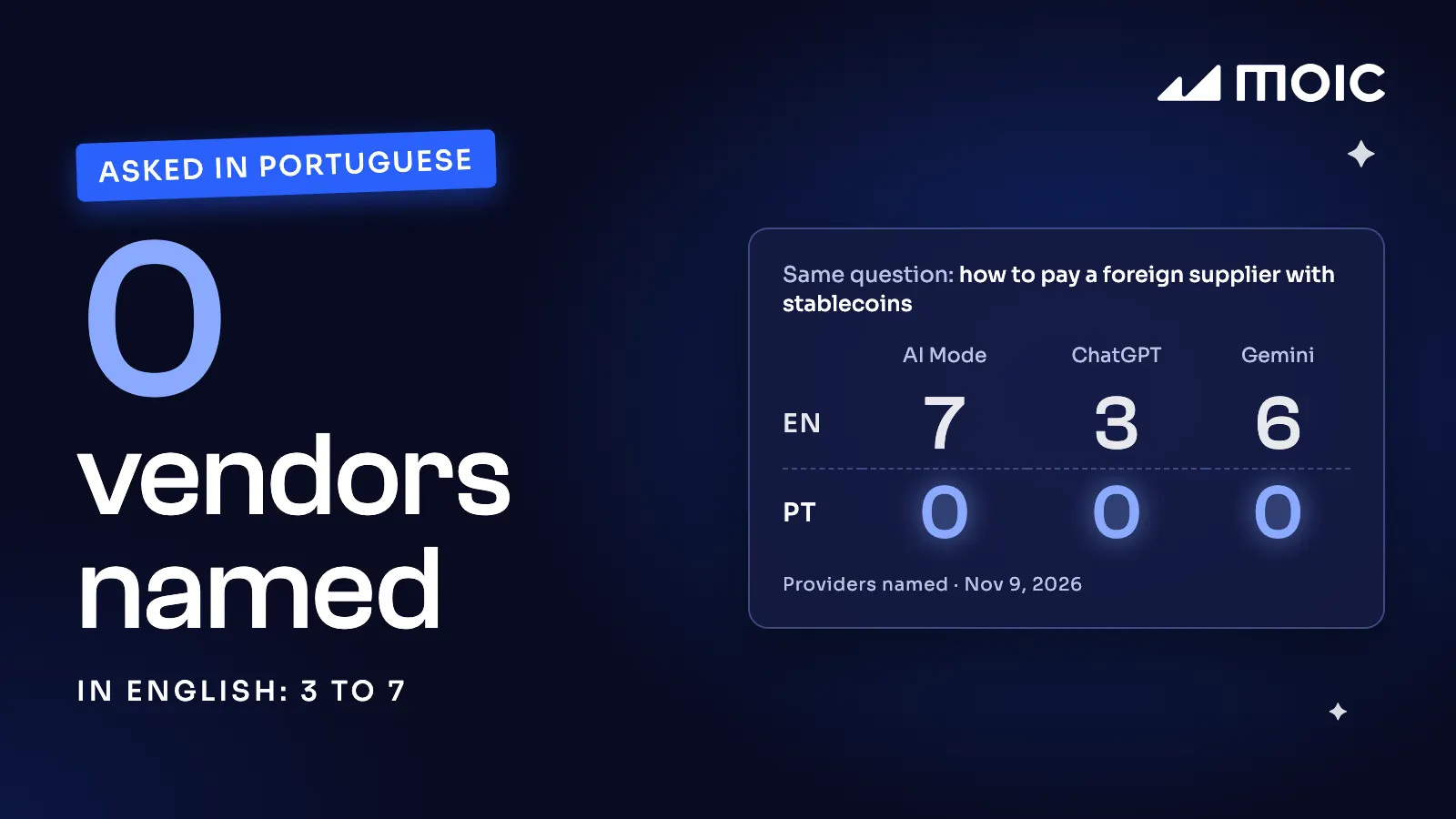
For fintechs and financial institutions entering Brazil or another Latin American market, we turn findings like this into positioning, demand and pipeline. Our tracking found a related gap on the Portuguese side, where three engines named no provider when asked about paying a foreign supplier with stablecoins. To see what the engines say about your own market, book a free diagnosis.
Nothing here is legal advice; it describes what we observed in the market.
FAQ
Do AI search tools search in English when I ask in another language?
ChatGPT often does, according to a Peec AI study of more than 10 million prompts: 43% of the fan-out queries for non-English prompts ran in English. OpenAI and Google do not say how they choose the language of these queries, and we found no comparable data for Gemini, AI Mode or Perplexity.
What changed on November 6, 2026 for crypto companies in Brazil?
From that date, banks, payment institutions and other BCB-authorized institutions can no longer carry out virtual asset operations with unauthorized service providers, except where the rule allows it. The original date was October 30, 2026; the BCB moved it to November 6 (source).
Do AI engines update when a regulation changes?
They can only reflect a change if they retrieve a page that describes it. In our November 9 snapshot, ChatGPT gave the new date when asked in Portuguese and the old one when asked in English.