How often should you post on LinkedIn in 2026?

Tuti NicolaSocial & Growth Manager
10 min read
One of the most common questions about LinkedIn content is how often to post, and which pace is worth keeping. For most brands, executives and professionals, the answer is two to five posts a week, kept steady. Buffer’s analysis of more than 2 million posts found that when the same accounts posted more often, each post earned more impressions (source). A steady pace beats volume because it builds a habit in your audience and gives you data to learn from.
What does LinkedIn do for brand positioning and thought leadership?
On LinkedIn, the posts of a brand and of the people who lead it shape how the market sees that brand: what it knows, what it stands for and who it serves. Thought leadership is the part of that content in which a company or its leaders share what they know about their field. The latest edition of the Edelman–LinkedIn B2B Thought Leadership Impact Report, published in 2025, surveyed 1,934 US decision-makers on LinkedIn and looked at “hidden” decision-makers: people who influence a purchase without being a company’s main contact (source). Among them:
- 71% say thought leadership is more effective than conventional marketing or sales materials at showing a company’s potential value.
- 64% trust it more than marketing materials and product sheets when assessing what a company can do.
- 71% have relatively little or no interaction with sales reps.
- 95% say a company that consistently produces high-quality thought leadership makes them more receptive to its sales or marketing outreach.
These numbers come from business buyers, and the lesson applies to any brand: many of the people who form an opinion about a company never talk to it, and what the brand and its leaders publish on LinkedIn becomes their picture of it. The 95% tie that picture to frequency, because the receptiveness the survey measured depends on a company publishing consistently.
How often should you post on LinkedIn?
Two to five posts a week is the range that works for most accounts. Buffer analyzed more than 2 million posts from over 94,000 LinkedIn accounts and compared each account’s busier weeks with its quieter ones, so the lift below compares each account with itself (source).
| Posts per week | Impressions per post, vs. 1 a week | Engagement rate, vs. 1 a week | Buffer’s reading |
|---|---|---|---|
| 1 | Baseline | Baseline | Minimum presence |
| 2 to 5 | +1,182 | +0.23 points | The “sweet spot” for most accounts |
| 6 to 10 | +5,001 | +0.76 points | To accelerate growth |
| 11 or more | +16,946 | +1.40 points | Maximum growth, if quality holds |
Buffer found the gains for accounts with 500 followers and for accounts with 50,000, and its own analysts attach a condition to every step up: the gains last as long as quality stays high. Richard van der Blom, whose yearly Algorithm Insights report on LinkedIn reach covered 1.3 million posts in its 2026 edition, told the Creator Science podcast that two to three posts a week are enough for the average creator, and that filling a daily calendar with memes and quotes does not help (source). For company pages, LinkedIn’s own guidance says pages that post weekly see twice the engagement with their content (source).
Our recommendation is at least 3 posts a week, a pace that a CEO writing their own posts, a marketing manager running a company page or a social media manager handling several profiles can keep for months, which gives about 13 posts per quarter to compare.
Why is consistency worth more than volume?
Consistency is what turns posts into a presence. Three reasons stand out:
- Your audience builds a habit. In the Edelman–LinkedIn survey, 63% of hidden decision-makers spend more than an hour a week reading thought leadership (source). An account that shows up on the same days each week becomes part of that hour.
- You cannot predict which post will take off. In an internal analysis of one of our accounts, detailed below, 3 of the 38 posts published in 90 days brought most of the reach, with no way of knowing in advance which ones they would be. A steady cadence gives each good idea a chance to be one of them.
- You get enough results to learn from. Judging a strategy by one viral post, or one quiet one, leads to the wrong conclusions. A quarter of steady posting shows which topics, hooks and formats work for your audience.
What did 90 days of posting 3 times a week show in one of our accounts?
We looked at 90 days of analytics, from August 8 to November 5, 2026, for one of the LinkedIn accounts of the MOIC Digital team. The account published 38 posts in that period, about three a week, and posted every week. Together they earned 594,451 impressions, reached 302,079 members and brought 2,070 new followers.
The reach was very uneven. One post, published on August 12, earned 360,052 impressions, 61% of the period’s total, and the account gained 614 followers in the two days after it. The median post earned 1,939 impressions. Only three posts passed 40,000 impressions, and all three were published in weeks with three or four posts.
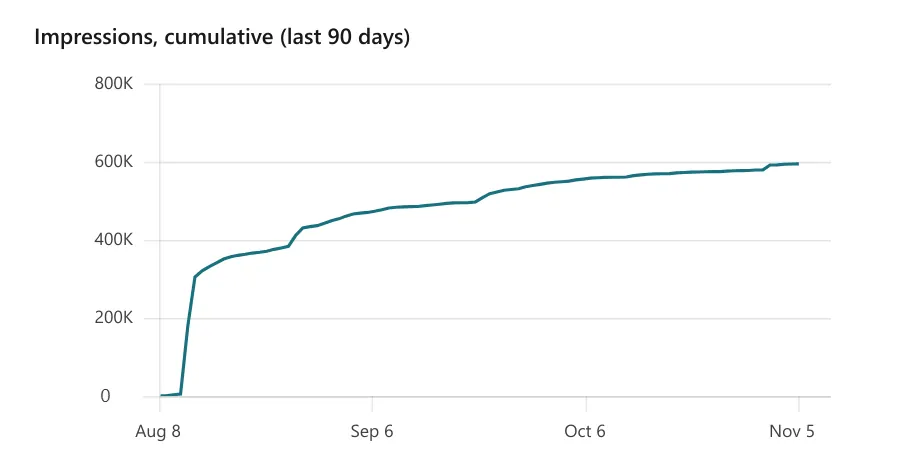
Cumulative impressions of one MOIC Digital team account in LinkedIn analytics, August 8 to November 5, 2026. Axis labels translated from Portuguese.
| Posts that week | Full weeks | Median impressions per week | Median new followers per week |
|---|---|---|---|
| 1 to 2 | 3 | 16,681 | 76 |
| 3 | 5 | 29,951 | 106 |
| 4 | 4 | 37,708 | 209 |
Twelve weeks of a single account are a small sample, and the three biggest posts fell in weeks with three or four posts, which pulls up the medians for those weeks. Even so, the direction matches Buffer’s study: in the weeks the account published more, it reached more people and gained more followers.
The conclusion we draw is practical. The post with 360,052 impressions was one of the 38 the account published to keep its pace of three a week, and on its own it brought 61% of the period’s impressions. Since there is no way to know in advance which post will reach that far, consistency is what creates the chances: every well-made post published on schedule is one more opportunity to reach a much larger audience than usual.
Why can a post flop even with a steady cadence?
Posting frequency affects each post through the account. A steady cadence keeps the account active and its audience used to seeing it, and that audience is the first to react when a new post goes up. Buffer’s data shows the effect on single posts: in the weeks an account posted more often, each of its posts earned more impressions (source).
Our account pointed the same way. The five posts published in weeks with only one or two posts had a median of 1,066 impressions, against 2,519 for the 31 posts published in weeks with three or four. Part of that gap has another cause: most of the quieter weeks fell in October, when the whole account was reaching fewer people. After the wave from its biggest post had passed, the median post went from 3,230 impressions in August and early September to 1,366 in October and November.
A steady cadence improves how the account performs as a whole, and a single post can still flop. In the same 90 days, while posting three times a week, the account had posts with 293 and 423 impressions. When a post’s reach stalls, it is usually the sum of several factors. These are the ones we check:
| Factor | What happens | What to do |
|---|---|---|
| No clear audience | The first people who see the post share no interest in the topic, so few react and the post stops there | Write for one defined audience and grow your network around it |
| No defined editorial line | Topics change from post to post, so neither LinkedIn nor your readers link the account to a subject | Keep most posts on two or three territories, as in how the LinkedIn algorithm works in 2026 |
| Weak hook | The first two lines do not stop the scroll, so nobody reads the rest | Open with a result, a specific number or a concrete situation |
| Generic content or AI slop | Without a case, a number or an opinion of your own, the post reads like any other, as happens with AI slop: text generated by AI and published as it came out | Add the example that only you have, and rewrite AI drafts in your own voice |
| Wrong format for the idea | A framework in plain text is harder to follow than the same framework in a carousel | Use carousels for frameworks and steps, and text for opinions and stories |
| Silent first hour | Nobody comments and the author is not around to reply | Stay 10 to 15 minutes after posting to answer comments |
| Friction | An external link in the body, an empty request like “comment YES”, a stack of hashtags | Keep the main idea in the post and ask questions only someone with context can answer |
| Cadence | Posting too rarely keeps the audience cold, and posting too often without quality spreads its attention thin | Pick the highest number you can sustain with quality |
How to set a LinkedIn posting cadence you can keep
- Choose a number you can sustain for three months. Three posts a week on fixed days is a good start for most executives and brands.
- Give each post a role. Mix discovery, depth, proof and practical content across the week, as in our organic content strategy.
- Stay after you publish. Van der Blom blocks 10 to 15 minutes after each post to reply to comments (source).
- Review after six to eight weeks. Compare topics, hooks and formats over the whole period.
- Raise the volume only when quality holds. Buffer ties the gains of higher frequency to keeping the quality of each post.
Turning expertise into a steady LinkedIn presence
MOIC Digital is a revenue-driven partner for B2B onchain finance companies. We help them and their executives turn what they know into a consistent LinkedIn presence that reaches decision-makers, as part of our marketing and demand work.
FAQ
How many times a week should a company or an executive post on LinkedIn?
Two to five times a week works for most accounts, and three is a sustainable starting point. Buffer’s study of more than 2 million posts found that accounts got more impressions per post in the weeks they posted two to five times than in the weeks they posted once.
Is posting every day on LinkedIn too much?
Daily posting only helps if each post keeps its quality. Buffer found gains up to 11 or more posts a week, provided quality holds, while Richard van der Blom says two to three posts a week are enough for the average creator.
Does posting more often make a post go viral?
Not on its own. In 90 days of one of our accounts, only 3 of 38 posts passed 40,000 impressions, all of them in weeks with three or four posts. Frequency gives more posts a chance to reach a larger audience, and the hook, the topic and the format decide how far each one goes.
Why did my LinkedIn post flop?
Usually because of the audience, the topic or the first lines, more than the posting frequency. Check whether the post spoke to a defined audience, stayed within your usual topics, opened with a strong hook and had someone replying in the first hour. Frequency acts through the account, by keeping your audience used to seeing you.
What role does LinkedIn play in brand positioning and thought leadership?
It is where a brand and its leaders show what they know to the people who will judge them. In the 2025 Edelman–LinkedIn report, 71% of hidden decision-makers had little or no interaction with sales, and 95% said consistent, high-quality thought leadership makes them more receptive to a company’s outreach.