This Is Probably the Best Hack for Your Company to Be Found by AI Agents

MOICMOIC Digital
9 min read
The best hack for being found by AI agents may be to answer your buyers’ question in their own language. Everyone in payments is fighting over the same AI answers: the English ones. When MOIC Digital asked three AI engines in Portuguese how a Brazilian company can pay a foreign supplier with stablecoins, none of them named a single provider. We think that is the most valuable opening in AI search today, and almost nobody is competing for it.
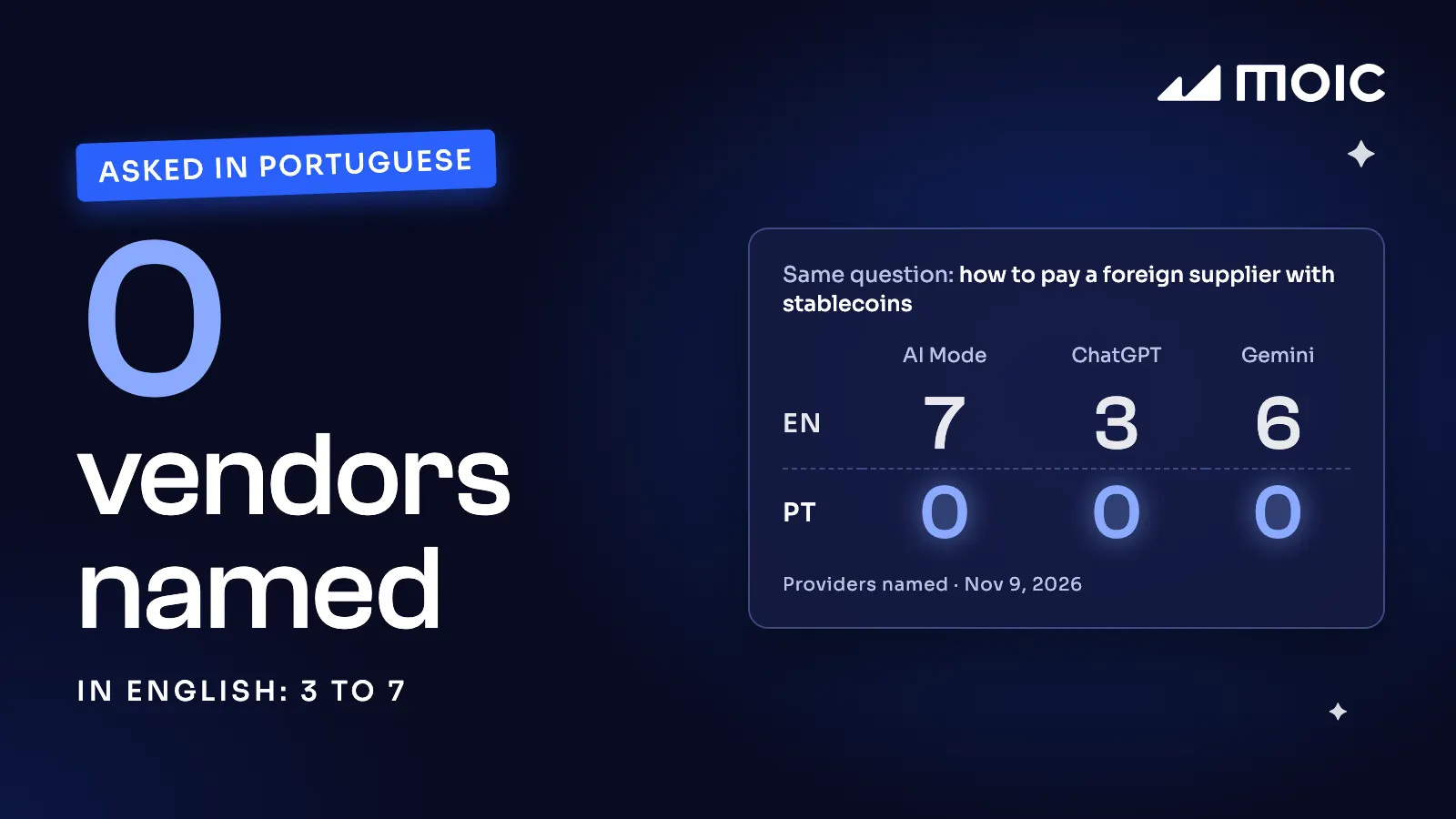
Here is what we found. On November 9, 2026, we asked ChatGPT, Gemini and Google’s AI Mode how a company can pay a foreign supplier with stablecoins. In English, each engine named between three and seven providers, among them Circle, Bridge, BVNK, Nium and Stripe. In Portuguese, from Brazil, none of the three named a single provider. The only brand in those answers was Tether, mentioned by ChatGPT as the issuer of USDT.
The Portuguese answers were not thin. ChatGPT’s ran over 7,000 characters. It walked through the Central Bank of Brazil (BCB) rules, limits, documents and taxes, worked a US$50,000 invoice example, told the reader to “use an authorized provider”, and stopped. It never said which one.
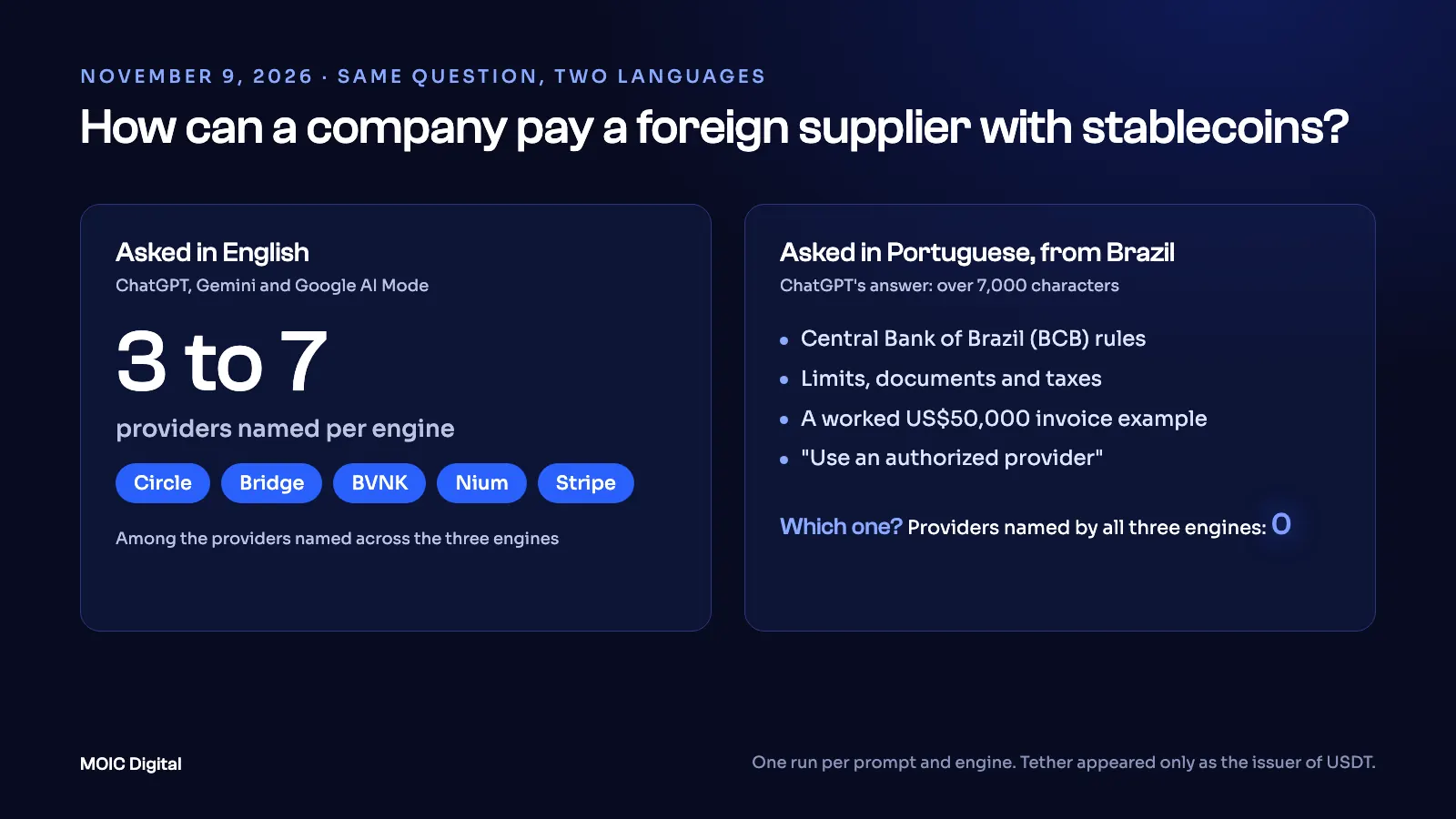
That is the slot. Google has offered AI Mode in Brazilian Portuguese since September 2025, saying a global Search “requires a nuanced understanding of local information” (source), so a Brazilian buyer can ask the question in their own language, get a full answer, and come away without a single company to call. On the day we looked, no stablecoin or payments company held it.
Same question, four versions
We track 60 buyer prompts across the three engines. Four of them ask, in different markets, some version of “can a company pay or get paid across borders in stablecoins”. This is what each engine named on November 9:
| Prompt | Language and market | AI Mode | ChatGPT | Gemini |
|---|---|---|---|---|
| How can a B2B company pay international suppliers with stablecoins? | English, US | 7 providers | 3 providers | 6 providers |
| ¿Cómo pagar a proveedores en el exterior con stablecoins desde México? | Spanish, Mexico | 2 (Bitso, Cobre) | 3 (Bitso, BVNK, Circle) | 3 (Bitso, Cobre, Koywe) |
| Como uma empresa brasileira pode pagar um fornecedor no exterior com stablecoin? | Portuguese, Brazil | 0 | 0 | 0 |
| ¿Es legal que una empresa en Argentina cobre en USDT? | Spanish, Argentina | 0 | 0 | 0 |
The Argentine prompt asks whether something is legal, a different intent from “how do I do it”, so a legal answer is expected there. The Brazilian prompt asks how to do it, the same intent as the English one. That is the comparison that matters.
This is one run per prompt and engine on one day. AI answers vary between runs, and SparkToro’s study of 2,961 runs found that AI tools return the same list of brands less than once in 100 tries (source), so a second collection could name a provider. What one day shows is how each answer was put together.
What were the Portuguese answers built from?
When an engine names no vendor, it is worth looking at what it cited instead.
ChatGPT’s Portuguese answer carried 25 links. 22 of them pointed to Brazilian government domains: gov.br, bcb.gov.br and the Federal Revenue’s rules site. Its Argentine answer was similar: 19 of 20 links went to government domains such as argentina.gob.ar, the tax agency ARCA and the central bank BCRA.
Gemini and AI Mode cited fewer pages, and more of them private. In Brazil they included a law firm, a legal news site and the Superior Court of Justice. In Argentina they included a crypto accountant, a tax publisher and a law firm.
The pattern held beyond these four prompts. Across the 29 prompts in our set about stablecoins, tokenization, regulation and LATAM neobanks, we sorted every cited domain into broad groups. Government and regulator domains made up about 44% of the citations in Portuguese answers, about 35% in Spanish answers and about 16% in English answers. The grouping is ours and some domains are hard to classify, so read those as rough shares.
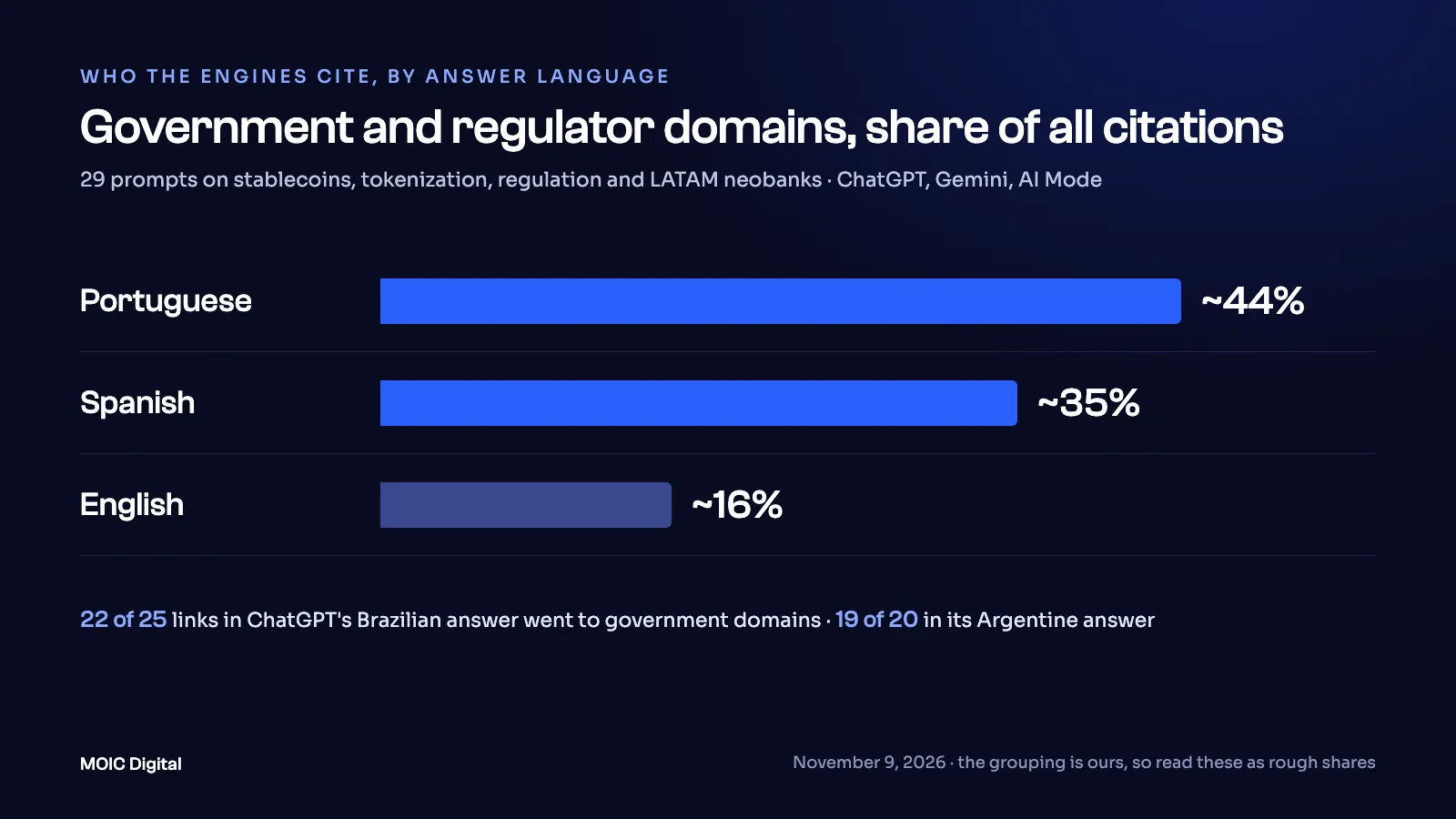
In Portuguese, then, a vendor’s page is up against the Central Bank and the country’s law firms.
The engines read vendor pages and left the names out
Two vendors did make it into the Portuguese sources, though not into the answers.
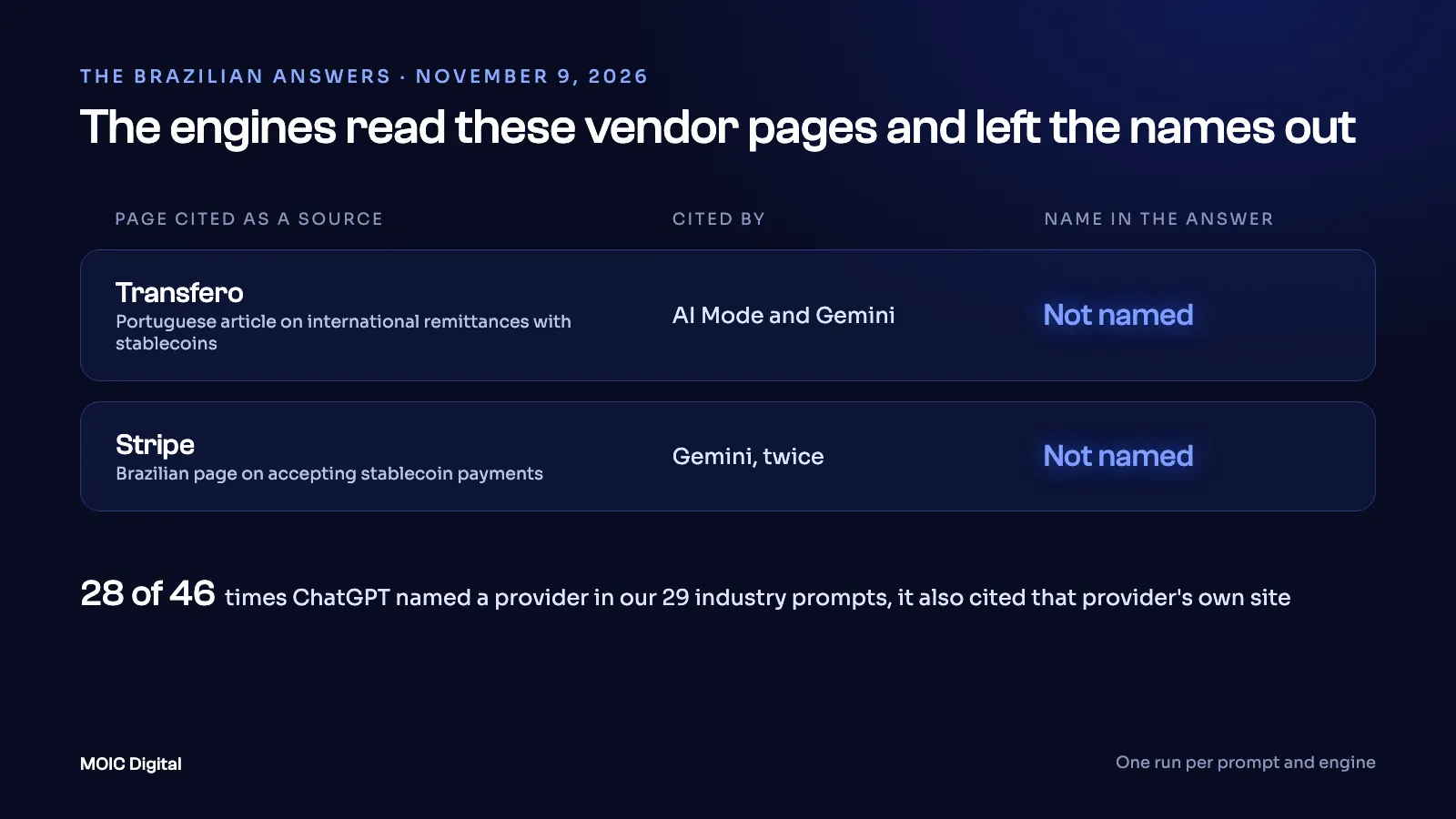
Both AI Mode and Gemini cited the same Portuguese article by Transfero, a Brazilian stablecoin company, about international remittances with stablecoins (page cited). Gemini also cited Stripe’s Brazilian resource page on accepting stablecoin payments, twice (page cited). Neither company’s name appears in either answer. The engines used the pages for the procedure and kept the brands out.
Elsewhere the two usually went together. Across the 29 industry prompts, when ChatGPT named a provider, it also cited that provider’s own site in 28 of 46 cases. In the Brazilian answers, the vendor’s page fed the answer and the vendor went unnamed.
Lily Ray’s analysis of AI Overviews for “best software” queries reached a related result in a different setting. She found Google may cite a vendor’s self-ranked list while leaving that vendor out of the answer (source). Being read by the engine and being named by it are separate outcomes, and they can come apart.
Published research on language and AI search has looked at which types of sources get cited. Profound’s study of 3.25 billion citations found that query language changes the mix of social and video sources an engine cites, sometimes more than geography does (source). That study does not look at whether vendors get named. Our snapshot suggests that in Portuguese, for this question, they did not.
Why does the Brazilian answer look like a legal memo?
The regulation gives the engines a reason to lead with rules. Since February 2, 2026, Resolution BCB 521 has treated international payments and transfers made with virtual assets, and the purchase or sale of fiat-referenced virtual assets, as part of the foreign exchange market. Only virtual asset service providers authorized for that market can offer them (source). Since October 1, 2026, Resolution BCB 561 has barred virtual assets, stablecoins included, as a means of settlement in the eFX international payment service (source). The Block notes the rule does not ban crypto transfers in Brazil outright (source).
A question with that much regulation behind it gets an answer about regulation. The three engines did not agree on the details, either. AI Mode led with Resolution 561. ChatGPT walked through buying USDT or USDC and sending it to the supplier’s wallet within the limits of Resolution 521. Gemini cited 521 and a US$100,000 cap per operation. We are not judging which picture is legally correct; that is a question for Brazilian counsel.
Mexico shows the slot can be filled. In the Mexican answer, Gemini named Cobre and cited Cobre’s Spanish-language page for Mexico five times (page cited). AI Mode and ChatGPT both named Bitso and cited Bitso pages.
How can vendors selling into Brazil get named by AI agents?
They can give the engines a Portuguese page that answers the buyer’s literal question, with the company’s name in the sentences that carry the answer. Five steps:
1. Write the Portuguese page that answers the literal question. The engines already wrote the structure for you: which rule applies, step by step, limits, documents, taxes. A page in Brazilian Portuguese titled with the buyer’s question, built in that order, with each BCB resolution linked and a visible “updated on” date, gives the engine what it is already looking for.
2. Put your name and status in the sentences that carry the answer. The engines took the procedure from Transfero’s and Stripe’s pages and left the names behind. A procedure written in general terms can be lifted without its author. A sentence like “[Company] is authorized by the BCB to operate in the foreign exchange market under Resolution 521, so the payment runs as…” states the fact the answer needs with the company as its subject. Whether that changes what the engines do is a hypothesis to test over several weeks, not a proven fix.
3. Publish with the experts the engines already cite. In Brazil those are law firms and legal news sites. In Argentina they were a crypto accountant, a tax publisher and a law firm. A guide written with your legal counsel and published on both sites puts your name on a source type the engines already trust for this question. Mentions off your own site seem to matter as well: in Ahrefs’ study of 75,000 brands, mentions of a brand across the web had the strongest correlation with its visibility in Google’s AI Overviews, 0.664 against 0.218 for backlinks, though Ahrefs notes correlation is not causation (source).
4. Track the Portuguese prompt as its own metric. Run the same question in Portuguese every day across engines and record two things: whether any provider is named, and whether your pages are cited. Watch the trend over weeks, because one day’s answer can change the next. Rand Fishkin reached the same conclusion after SparkToro’s study of repeated runs (source):
“I’ve been swayed from my initial position and now believe visibility % across dozens to hundreds of prompts run multiple times is a reasonable metric.”
5. Do not count on your English page. In this snapshot, the English answer named providers and the Portuguese one did not, so ranking in English said nothing about the Brazilian buyer’s answer.
Turning these insights into action and revenue
We work with fintech and financial institutions on positioning, demand and pipeline, and a market entry like Brazil or Mexico is where these gaps show up first. Our services start with a free diagnosis, and the Hypernative case shows how we approached a growth opportunity in Latin America.
This article is a market observation, not legal advice.
FAQ
Do AI engines name stablecoin providers when asked in Portuguese?
In our November 9, 2026 snapshot, ChatGPT, Gemini and Google AI Mode named no provider when asked in Portuguese how a Brazilian company can pay a foreign supplier with stablecoins. They named three to seven when asked the same thing in English. It was one run per engine, so treat it as a snapshot, not a rule.
Is it legal for a Brazilian company to pay a foreign supplier with stablecoins?
Resolution BCB 521 treats international payments with virtual assets as part of the FX market, provided by authorized providers (source), and Resolution BCB 561 bars virtual assets as settlement in eFX from October 1, 2026 (source). How these apply to a specific operation depends on its structure. Check with Brazilian counsel.
How did you count the providers?
We matched each answer’s text against a list of about 60 known stablecoin, payments and tokenization companies, then read the answers to confirm. Token names (USDT, USDC) do not count as providers. Tether appears in the Brazilian and Argentine answers only as the issuer of USDT.