How we automated most of our sales team's operational work with AI

Matheus ChraimHead of Sales
11 min read

We automated most of the operational work of our sales team at MOIC Digital with Petros, a set of modules we built in-house. Petros registers and enriches leads, sends and checks LinkedIn connections, plans and sends each cadence, logs every reply in the CRM and runs 24/7 on a server, without depending on anyone.
Our business developers (BDs) stopped working on the CRM and now spend the day on the most important conversations with leads: one person handles seven LinkedIn profiles from a single inbox.
What problem did we solve?
Every sales team has the same operational pains: filling in the CRM, enriching lead data, preparing prospecting cadences and keeping a long list of small automations running. None of it closes a deal, and all of it takes time from the people who should be selling. Salesforce’s State of Sales 2026 found that the average seller spends 40% of their time selling (source). We built Petros to give the rest of that time back.
| A BD without Petros | A BD with Petros | |
|---|---|---|
| CRM | Filled in by hand, lead by lead | Kept in sync in real time, with locks against errors |
| Lead data | Looked up and typed in | Extracted from a LinkedIn URL, at no cost |
| Connections | Sent and checked one by one | Sent, checked and staged automatically |
| Next step | Decided case by case | Set by the cadence: when, which channel, what tone |
| Sending | Message by message | The day’s tasks sent on their own |
| Replies | Logged by hand, stages moved by hand | Read, logged and staged automatically |
| Research | Minutes of reading per company | A ready study in the lead’s card |
| Accounts per person | One | Seven, from one inbox |
How much time did Petros save?
Petros cut the time our sales team spends on operational work from 45 to 6.5 hours a week, about 86% less. Sending cadences took the most time: 30 hours a week before Petros, and 5 hours now. Enriching lead data went from 4 hours a week to 0.5, sending and checking connections from 6 to none, and planning cadences from 5 to 1.
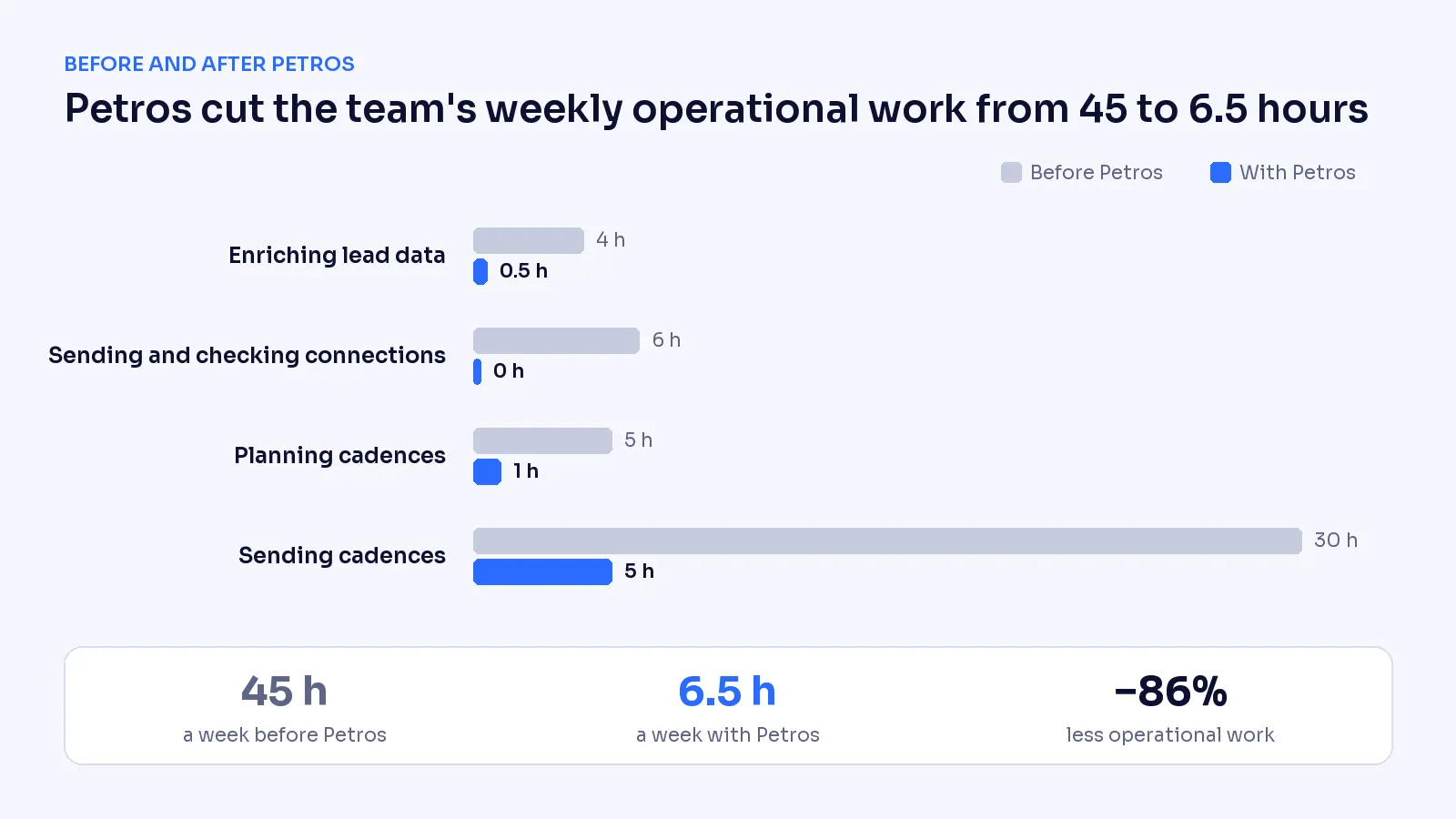
We put the time freed up into the work that closes deals: replying to leads strategically, preparing meetings and selling.
Why automate a process that already works?
Because a validated process is the one AI and code can run fastest. When the team already knows what a good lead looks like, when to follow up and when to stop, those decisions can be written as rules, and a system can apply them every day without waiting for anyone. Rather than inventing a new way of selling, we took the way our BDs already worked and removed the hours of operational work around it. Time is money in sales: every hour a BD spends on the CRM is an hour without a conversation with a lead.
Where did Petros start?
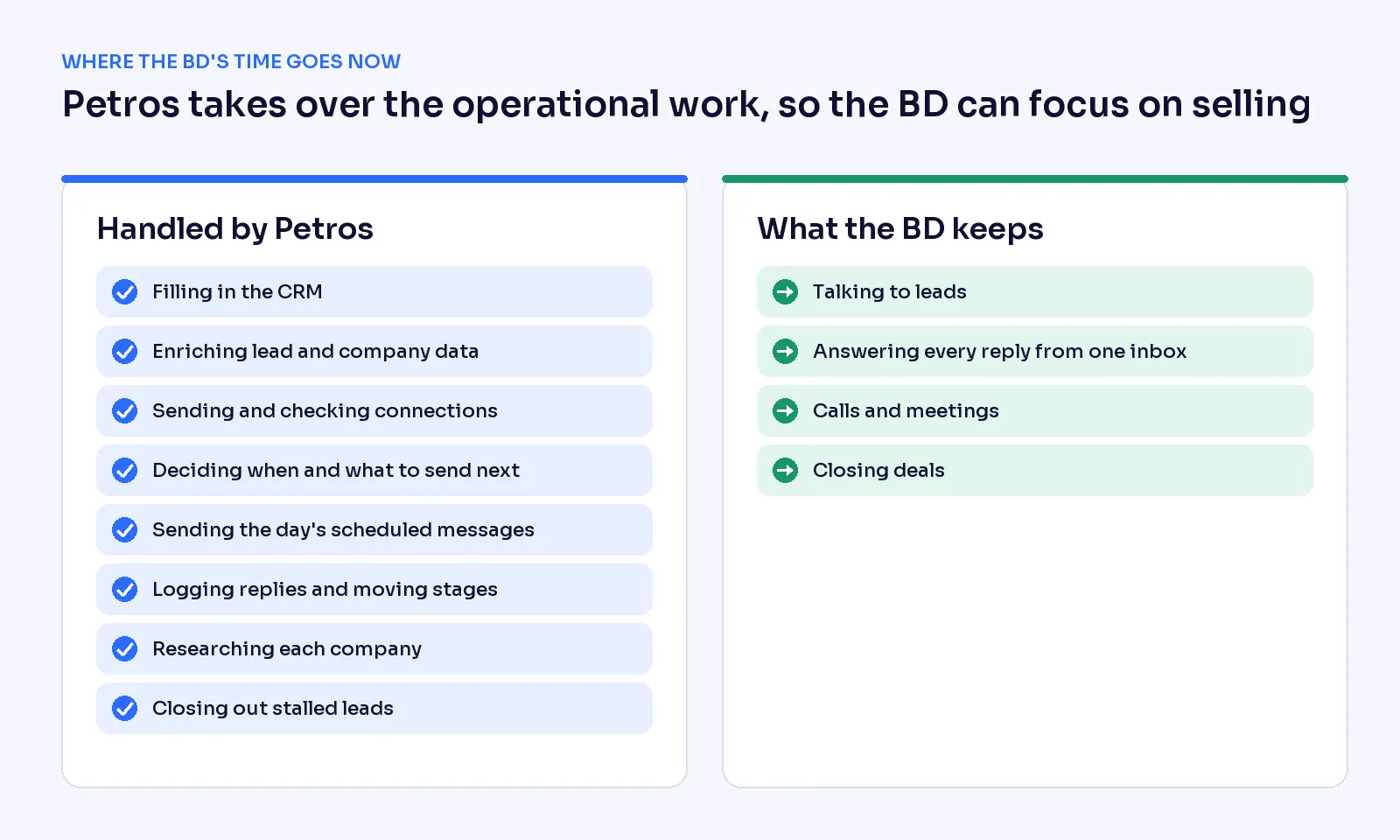
Petros started as a system to send automatic, customized messages to leads on LinkedIn, one per lead. It grew into much more than that, and we keep pivoting it. Today it is split into modules for managers and for sellers, each with its own purpose, and together they take the whole operational arm of the job off the BD: no more filling in the CRM, deciding when or what to say to a lead, moving stages or closing out leads that went cold.
How does Petros work?
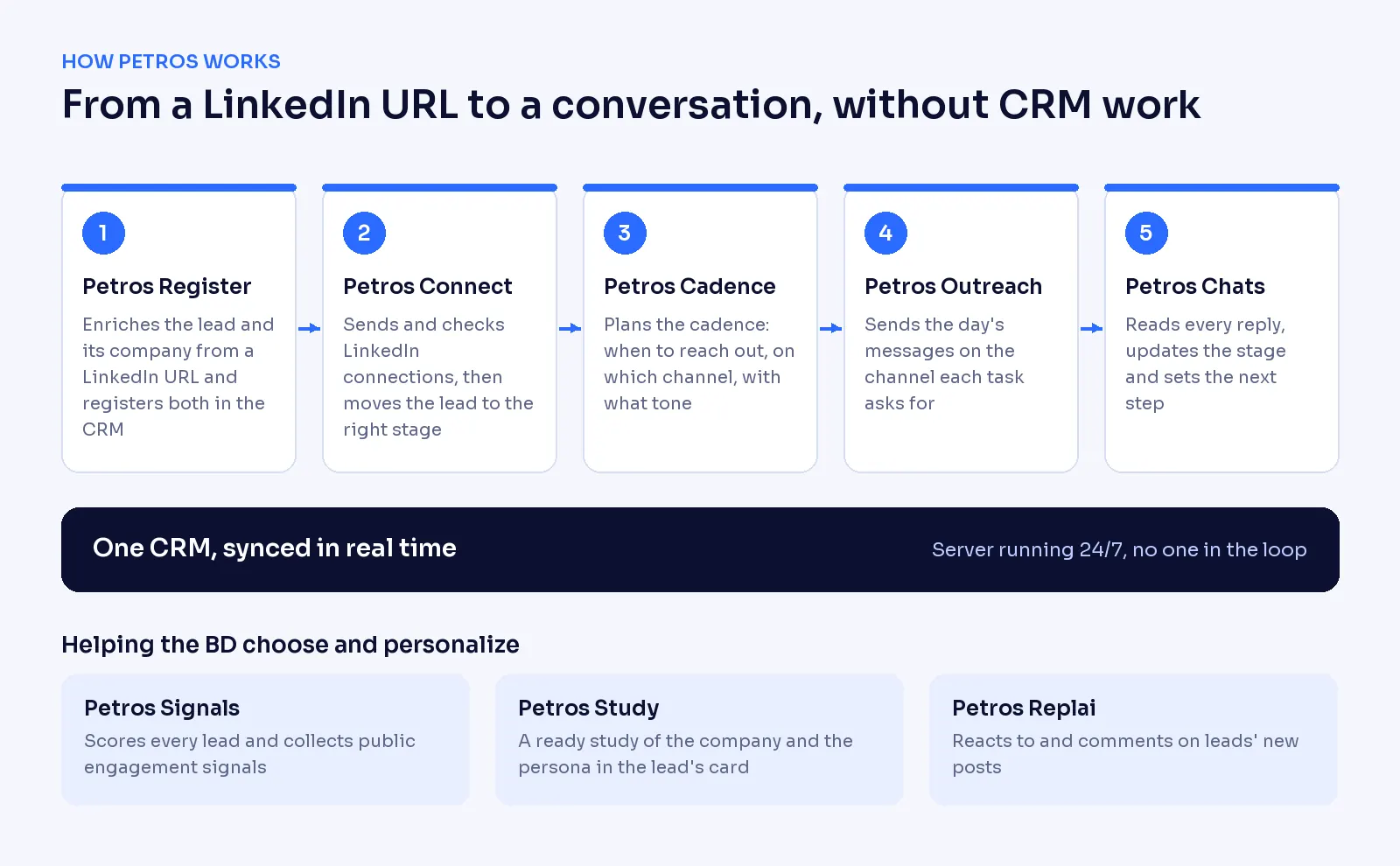
Petros follows the lead from a LinkedIn URL to a conversation. Five modules move the lead forward, three more help the BD choose and personalize, and all of them read and write the same CRM in real time.
What does each module take off the BD’s plate?
1. Petros Register: enrichment and CRM registration
The work it removes: looking up each lead and typing the data into the CRM.
How it works: with only a person’s LinkedIn URL, it extracts the person’s data and the data of the company they work at: role, country, language, segment, funding received, chain, token status, number of employees and more. The data comes from different sources and passes through an AI filter before it is registered in the CRM. It costs nothing to run. Because it talks to the CRM in real time, it also has locks that stop a wrong registration or one BD “taking” a lead that belongs to another.
2. Petros Connect: LinkedIn connections
The work it removes: opening lead after lead to send a connection request, then checking again and again who accepted.
How it works: it sends and checks connections on its own, fast, using only code and bots, with no AI cost. It also moves each lead to the right CRM stage based on the connection’s status.
3. Petros Cadence: planning each lead’s next steps
The work it removes: the question every seller asks, “what should I say to this lead, and when?”
How it works: it writes the whole planned cadence for a lead: which tasks to do, when, on which channel and with what tone. It accepts any number of cadences, for different segments, events, strategies and tests, each with its own rules, including when to stop. Unless the cadence uses fixed templates, it does not write the messages for you; it tells you when to reach out, through which channel and in what tone.
4. Petros Outreach: sending
The work it removes: sending each scheduled message by hand.
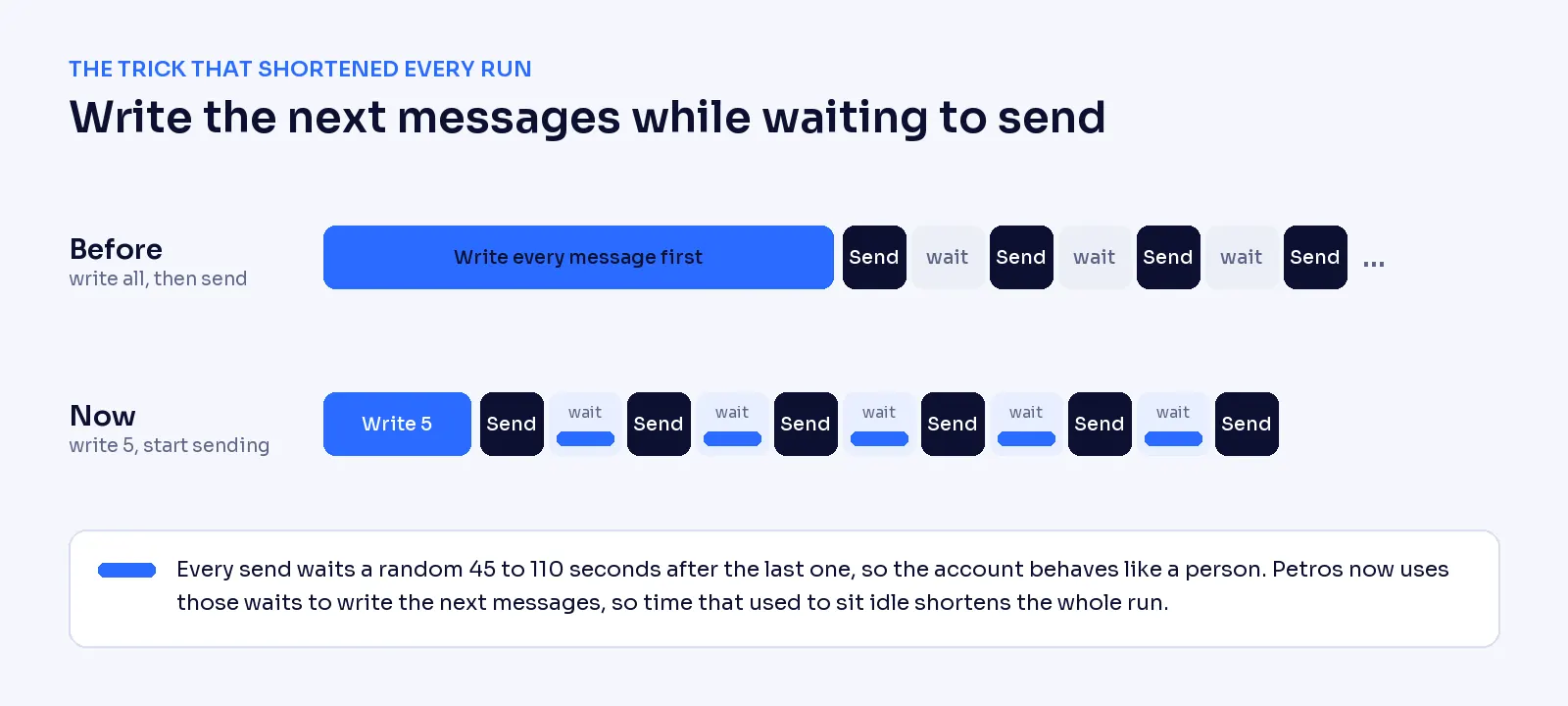
How it works: it reads the CRM, finds the leads with tasks due today (or overdue) and sends the messages on the channel each task names: LinkedIn, email or Telegram. Template cadences need no AI; customized cadences generate each message first, then send it. The system can send a message every two minutes. It could go faster, but LinkedIn would block the account, so every send waits a random 45 to 110 seconds after the last one.
That wait led to the change that shortened every run. The first version generated all the messages and only then started sending, which made the process very long. Now it generates five messages, starts sending, and uses each wait to generate the next ones.
5. Petros Chats: replies into the CRM
The work it removes: logging conversations, moving stages and closing tasks after every reply.
How it works: it reads every chat the BD has, on any platform (email, Telegram, LinkedIn), and records them in the CRM every day. It moves the lead to the right stage based on the reply, sets the next step and completes the BD’s pending tasks on that lead. With every conversation in one place, the team can measure reply rates, objections, hot leads and the tone of the answers. The BD spends the whole day in the conversation channels and none of it on the CRM. The CRM as the single source of truth is the core of RevOps for B2B onchain finance.
6. Petros Signals: lead scoring and engagement signals
The work it removes: guessing which leads to work first and how to approach them.
How it works: it runs the team’s lead scoring engine, rating each lead from the CRM fields and the conversation so far and flagging the priorities. It also collects public engagement signals: the kinds of posts a lead interacts with, who they talk to, how often they use LinkedIn. Those signals make each approach more specific, in the same spirit as qualifying accounts before the proposal.
7. Petros Study: a study of each company and persona
The work it removes: the minutes a BD spends reading news and websites to understand a company before reaching out.
How it works: it runs a full study of each company and persona: the market moment, who the company is, who the persona is, the recommended angle and the topics to avoid, with every source listed for a deeper look. The BD gets the report ready, inside the lead’s card.
8. Petros Replai: engagement with leads’ posts
The work it removes: keeping up with what every lead posts.
How it works: built with the support of our Intelligence Squad, it takes every lead in the CRM linked to a BD and monitors their posts in real time. When a new post goes up, it reacts (with the reaction you choose) and comments, so the BD stays visible to the lead and never misses a new interaction.
9. Petros Update and the maintenance modules
Petros Update keeps our team on the latest version of every module, so nobody misses what changed. A few smaller modules handle the occasional adjustments the CRM needs.
How does one person handle seven profiles?
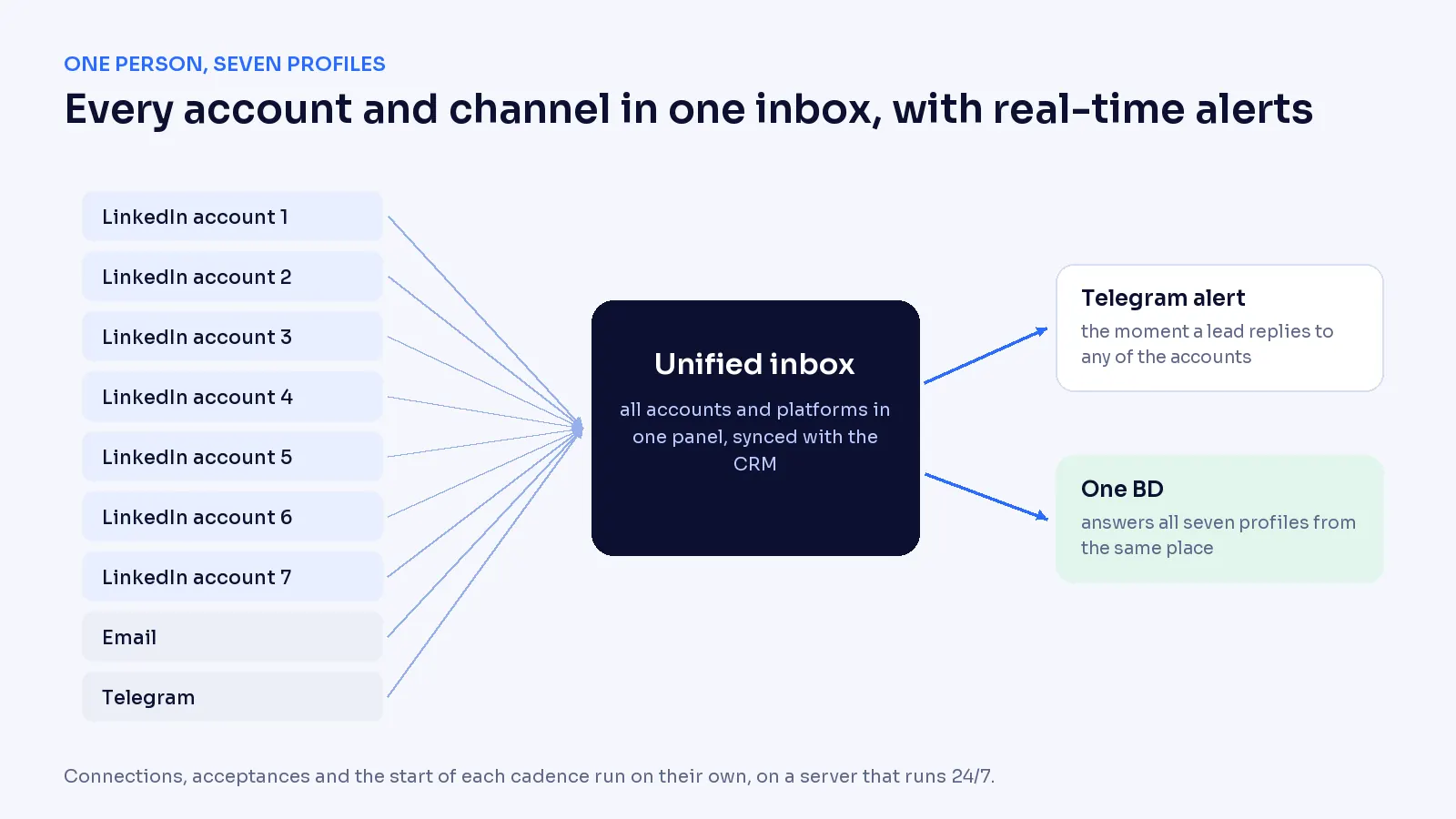
On top of the modules, we built an in-house system that connects several LinkedIn accounts at once and syncs them with the CRM. It follows every lead that comes in, sends and checks connections automatically, and starts the prospecting cadence as soon as a connection is accepted. A single panel brings the inbox of every account and platform into one place, and a bot sends the BD a Telegram alert the moment a lead replies to any of them. With that, one person manages seven profiles at the same time, answering all of them from the same place. It all runs on a server, 24/7, without depending on anyone.
How to build your own
Three lessons save the most time, from the mistakes worth avoiding:
- Avoid AI tools that promise to drive the browser for you. They are slow, they freeze, they drop often, and they are easier to detect than you would think.
- Do not pay for LinkedIn data enrichment. It can be done at scale at no cost.
- Do not expect a ready-made platform to fit. Most come with limits or a high price, and most of what you need you can build yourself.
And four that follow from how we built Petros:
- Start from the process you already run. Automating a validated process means writing down rules the team already follows.
- Use code before AI. Connections and template sends run on code and bots alone, at no AI cost. AI comes in where something must be read or written.
- Use the waits. Pauses that keep an account safe are time a system can spend preparing the next step.
- Keep the CRM as the single record, with locks. Real-time sync and safeguards stop wrong registrations and leads changing hands by mistake.
What is still open
Petros is still evolving, and we keep pivoting it as new needs come up. The next modules will come from the same place as the first ones: the operational tasks that still take a BD’s time away from conversations.
Principles
- Automate the process that already works.
- Code for what can be exact, AI for what must be read or written.
- The BD’s time goes to conversations; everything else goes to the system.
- One CRM, kept in sync in real time.
- Idle time is time the system can use.
Want your sales team selling more?
If your BDs spend their week on CRM work, talk to us about how we approach sales and pipeline at MOIC Digital.
FAQ
What is Petros?
Petros is the set of modules we built in-house at MOIC Digital to automate our sales team’s operational work. It registers and enriches leads, sends and checks LinkedIn connections, plans and sends cadences, logs every reply in the CRM and helps the team prioritize and research leads.
Does Petros send messages without a person?
Yes, for the tasks scheduled in each cadence. Template cadences are sent without AI, and customized cadences generate each message before sending. The BD handles the conversations that follow, from one inbox.
How does Petros keep LinkedIn accounts safe?
It sends at a human pace: each message waits a random 45 to 110 seconds after the previous one, about one every two minutes. It could go faster, but LinkedIn would block the account.
Does Petros use AI for everything?
No. Sending and checking connections and sending template cadences run on code and bots alone. AI comes in where something has to be read or written, such as filtering enrichment data, customizing messages and studying each company.
How many LinkedIn profiles can one person manage with it?
Seven at the same time, answering all of them from a single inbox with a Telegram alert whenever a lead replies.