Google launched Search profiles: how CEOs can get their own page

MOICMOIC Digital
10 min read
Google launched Search profiles, a page inside Google where you control what shows up when someone searches your name: photo, bio, links, featured posts and a follow button. The feature launched in the United States in June and has just arrived in Brazil, on October 27, 2026 (Google Brasil). To create yours you need 10,000 followers on YouTube, Instagram, X or TikTok. It is another opportunity to strengthen the presence, authority and reputation of the CEO, the brand’s main spokesperson.
About Google Search profiles
Search a CEO’s name on Google and you will see, next to the results, a block with a photo, a short description and a few links. Until now Google built that block itself from whatever it found online, and the description was often an AI-generated summary.
With a Search profile, that block becomes yours. Google announced the product in the United States on June 4, 2026 (Google) and launched it in Brazil on October 27. In Portuguese, Google calls it Perfis na Pesquisa.
| Before | With a Search profile | |
|---|---|---|
| Who builds the block for your name | Google, from whatever it finds online | You |
| Photo, bio and links | Chosen by Google | Chosen by you |
| Featured posts | None | Up to 8 pinned posts |
| Followers inside Google | Not available | A follow button that takes your content to Discover |
| Public page | Not available | A page on a Google domain |
What is a Google Search profile for?
It lets you decide how you appear on Google. In the profile you choose the photo, the bio, up to 8 links, up to 8 pinned posts and which accounts show up. The profile pulls content from the accounts you connect on its own, and what you publish shows up there within 24 to 48 hours (PPC Land).
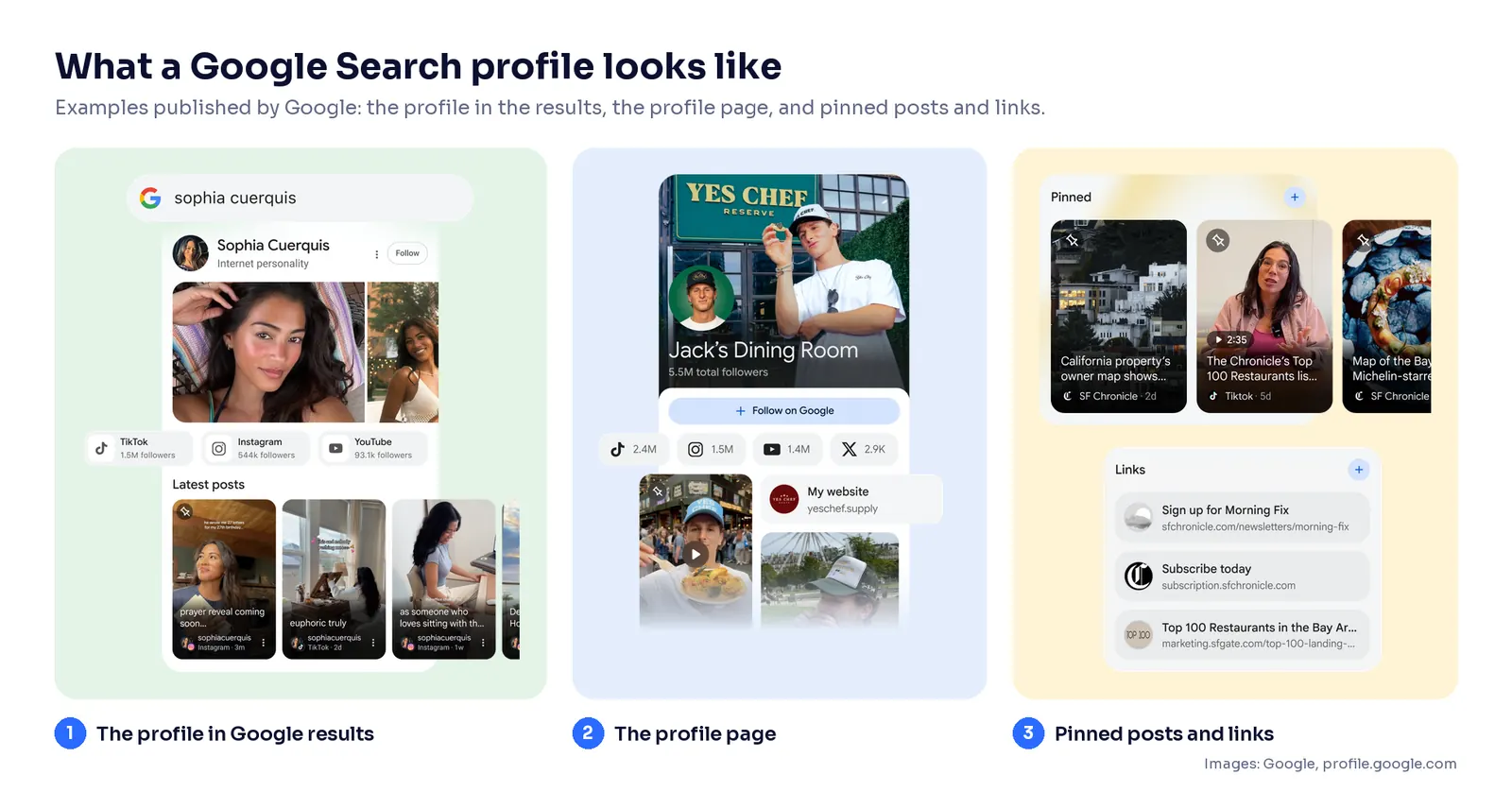
Examples of Search profiles published by Google on profile.google.com.
What are the advantages of a Google Search profile?
The biggest advantage is controlling the first impression. Before a meeting, investors, clients and candidates search the CEO’s name, and with a profile what they find is what you chose to show.
The other advantages:
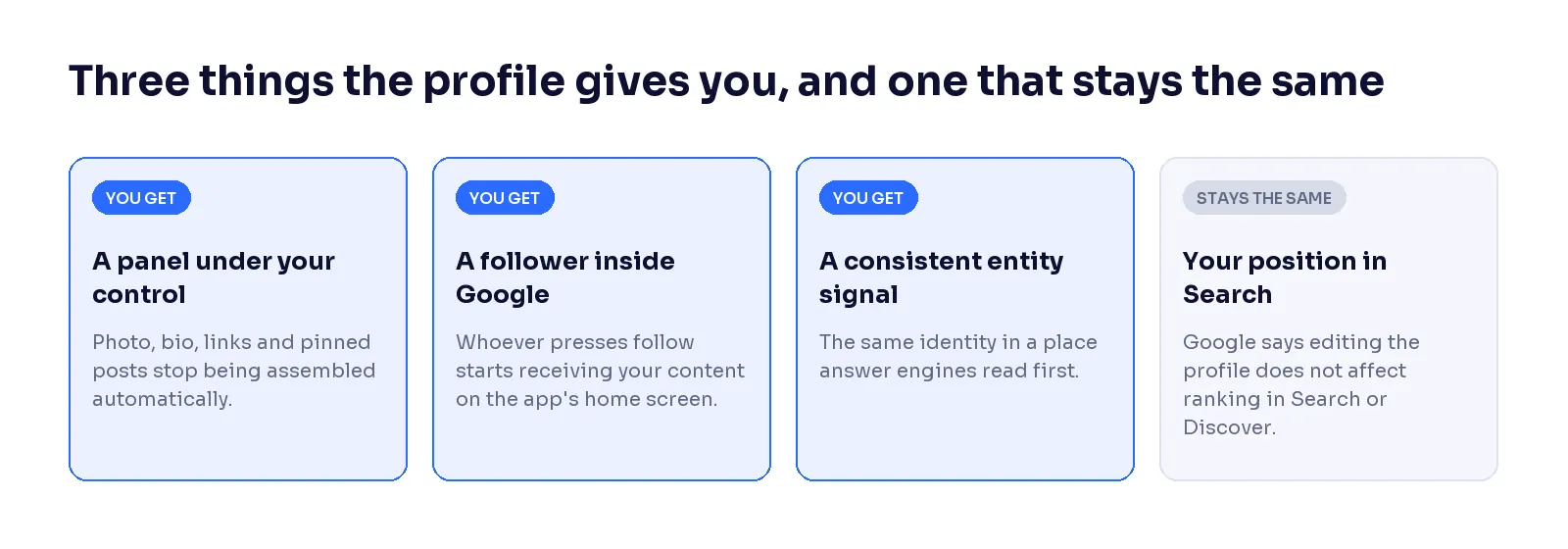
- Followers inside Google. Whoever presses follow starts receiving your content in Discover, the home feed of the Google app (Google).
- A public page on a Google domain that you can send to anyone.
- An organized identity in a place that search engines and AI tools read. We explain this further down, in the part about GEO.
The profile does not change your position in the results: Google says editing the profile does not affect how your content ranks in Search or Discover (PPC Land).
The advantage applies to people and publishers. For businesses and brands, Google says the knowledge panel stays the same and connected to the Google Business Profile (Google for Creators). That is why the winners are people: public figures, experts and content creators. For B2B companies, this means one more channel for the CEO’s presence and one more channel for relationships with clients, investors and the market.
Why did Google launch Search profiles now?
Our reading is that Google created Search profiles because it is losing clicks to AI answers. Across Chartbeat’s publisher network, traffic from Google Search fell 40.2% between July 2025 and July 2026, after a 21.9% fall the year before (Search Engine Journal). When the page has an AI summary, people click a result in 8% of visits, against 15% when it does not, according to the Pew Research Center (Pew Research Center).
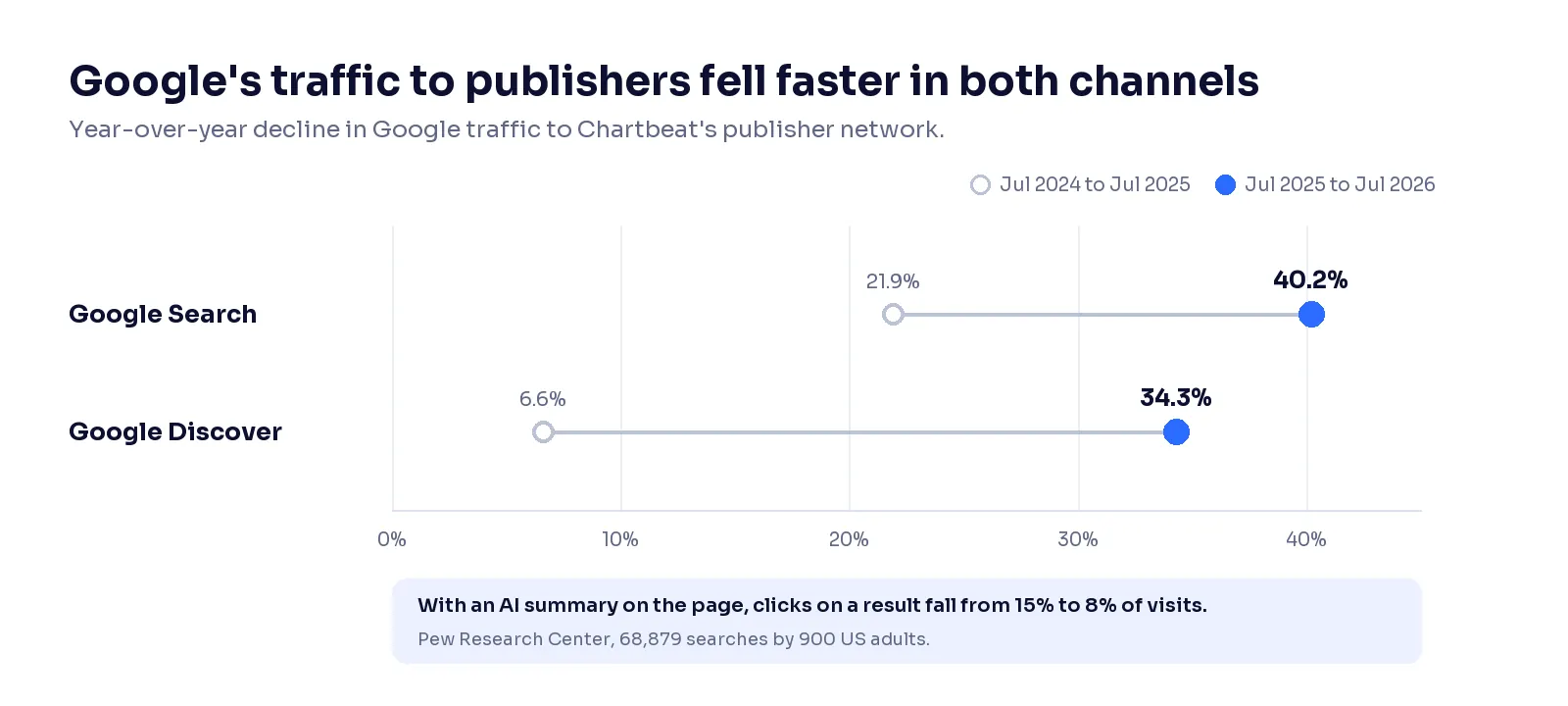
If clicks are disappearing, Google is trying to keep people another way: with followers. It reminds us of Netflix and the video rental stores, with one important difference. The rental stores waited for the decline to arrive, and Google is moving early, while it still owns the screen where people start their searches.
For a CEO who already meets the requirements, our recommendation is simple: create the profile now, while few people have one, and treat it as taking care of your own image on Google. It takes little time to set up and helps position both the CEO and the brand.
What we noticed in the first weeks
LinkedIn does not count
To create a profile, Google accepts followers from YouTube, Instagram, X and TikTok. LinkedIn was left out, and for companies that sell to other companies that matters: it is exactly where most B2B executives built their audience. A CEO with 40,000 followers on LinkedIn and 2,000 on Instagram, for example, cannot create a profile.
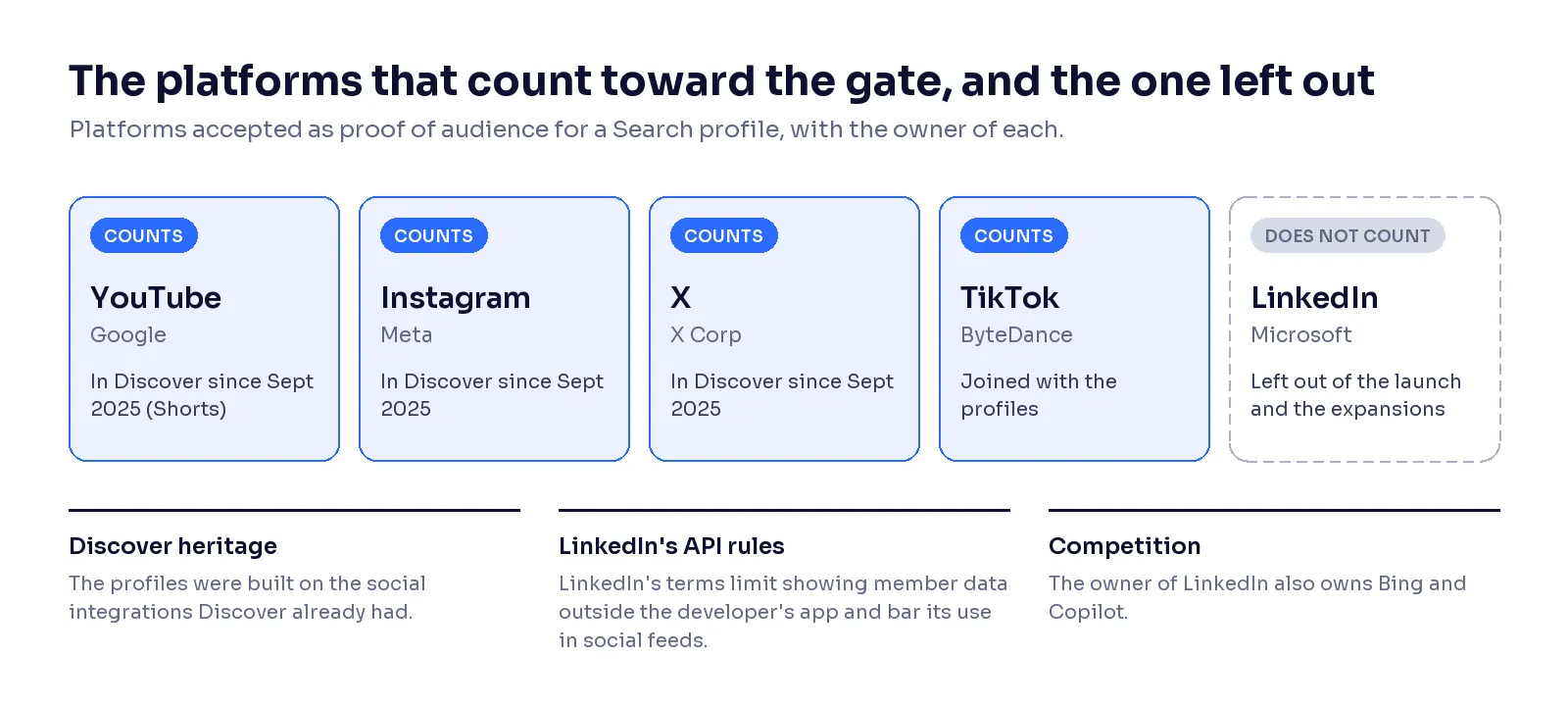
Google has not explained the absence, but three things help make sense of it:
- The profile grew out of Discover. In September 2025 Google announced that Discover would show posts from X, Instagram and YouTube Shorts, and mentioned “more platforms” without naming them (Google).
- LinkedIn’s rules. The terms of LinkedIn’s marketing API only allow member data to be displayed inside the app of whoever uses the API and forbid its use in social feeds (LinkedIn).
- Competition. LinkedIn belongs to Microsoft, owner of Bing and Copilot, which compete with Google.
In practice, a B2B executive who wants a profile needs 10,000 followers on one of those four networks, and the count does not add up across them. It pays to focus on one, usually X or YouTube. Our guide to an organic content strategy for social media helps build that audience.
An opportunity for those who arrive first
Search profiles are still new, and whoever creates one now gets ahead. Many people who already have enough audience have not created a profile yet, and many may not even know it exists. Google has not said how many profiles were created, but it has been making it easier to get in. In a little over three months, it lowered the minimum number of followers required to create a profile: it was 100,000 (300,000 on TikTok) at launch, then 35,000 in August and 10,000 on September 16 (Search Engine Journal). Our reading is that Google wants more profiles created, and the space is still open for those who arrive first.
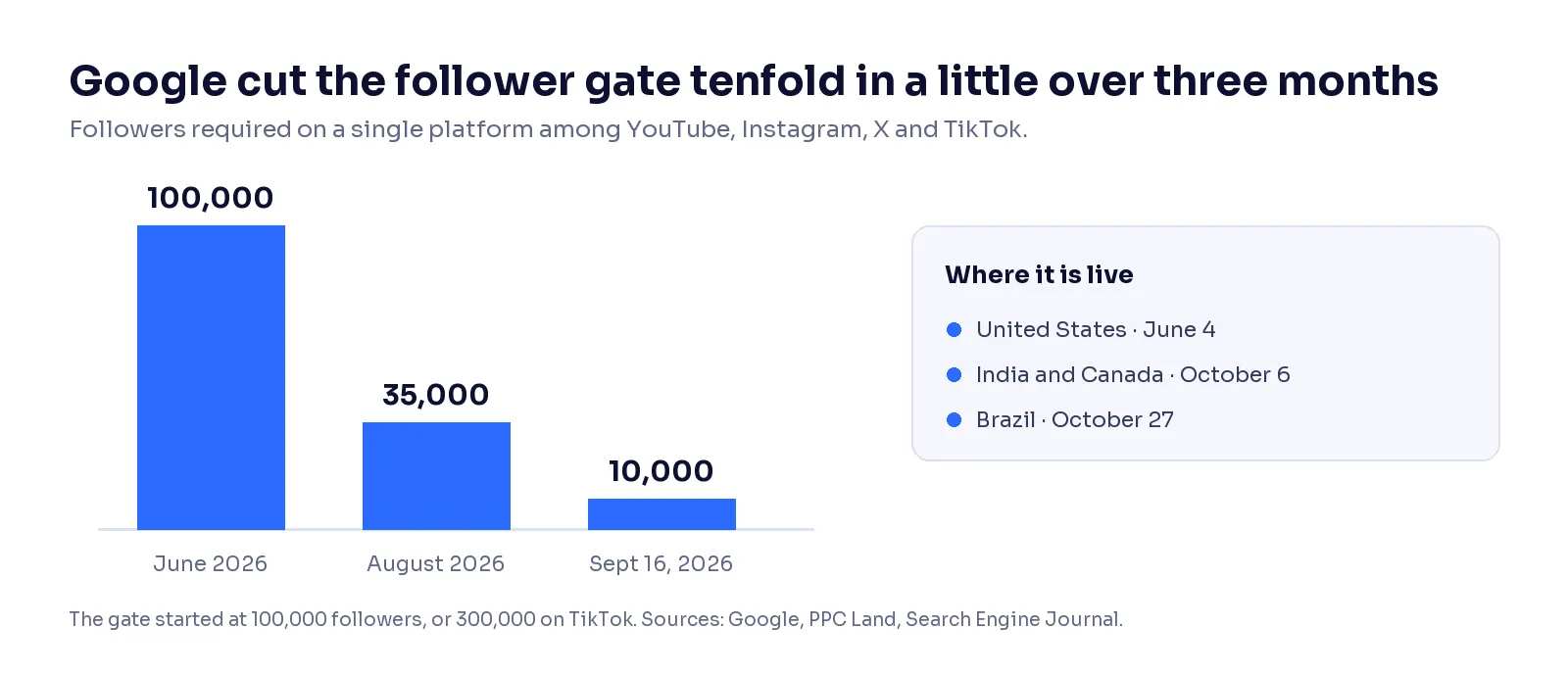
Being an early adopter makes a difference. Whoever creates a profile now takes that space on Google before competitors, learns the format without pressure and already has followers when the feature becomes popular. It is worth checking how many followers each executive in the company has on each network, because someone often already has more than 10,000 on one of them without knowing it.
How to create your Google Search profile, step by step
- Check that you meet the requirement. You need 10,000 followers on a single network among YouTube, Instagram, X and TikTok, and you must be 18 or older (PPC Land).
- Tidy up first. Make your name, bio and links match on the company website, your networks and LinkedIn.
- Go to profile.google.com/claim with your Google account.
- Connect the network where you have the 10,000 followers, so Google can confirm it is you.
- Take over the profile Google already built, or create one from scratch.
- Choose the photo, bio, up to 8 links and up to 8 pinned posts. Pin what you want a client to see before the first meeting.
- Add UTM tags to every link, so you know how many visits the profile sends to your site.
- Come back in 30 days and look at the visits that arrived and at the profile’s Insights panel, which is still in beta.
Google is releasing the product gradually. If the option does not show up for you on the first try, try again a few days later.
Creating the profile is the first step. Since it pulls content from the connected networks, the profile directly reflects the quality of the CEO’s presence on those channels, and inactive or unfocused networks turn into a profile showing old posts to whoever searches your name.
That is why the profile works best as part of an executive presence strategy, with a clear narrative about what the company stands for, a consistent editorial line and the same message across every touchpoint: the website, the CEO’s networks, LinkedIn, events and now Google itself. With that narrative aligned, every new channel adds authority to the brand.
What do Search profiles have to do with GEO, AI visibility and organic traffic?
For years, showing up on Google meant doing SEO: optimizing your website to climb the list of links. Today many people get a ready-made answer, written by AI tools such as ChatGPT, Gemini, Perplexity and Google’s own AI summaries, and never click a link. GEO (generative engine optimization) is the new SEO: the work of getting your brand and your CEO to appear and be cited in those answers.
In GEO, reputation weighs more than a position in a ranking. AI tools build their answers from what they find about a person or a company in many places, and in our reading they cite more readily those with a clear and consistent presence: the same name, the same description and the same positioning on the website, social networks, interviews and articles. A Search profile joins that set as a source about the CEO, hosted by Google itself and written by you.
The profile can also bring visits another way, through Discover. Discover is the home screen of the Google app, where news and posts suggested for each person appear without them having to search for anything, and whoever follows your profile starts seeing your content there. It is already Google’s main route to news sites: at the end of 2025, about 68% of the visits Google sent to those sites came from Discover, according to NewzDash (PPC Land).
For a CEO, this changes what it means to be present on Google. Appearing in a list of links counts for less, and presence depends more and more on identity: who you are, what you publish and who follows you. We wrote about why that work starts with the founder in why positioning is a founder problem.
Want help building your CEO’s presence?
MOIC Digital works with financial companies on positioning and executive presence that turn into pipeline. See how we work on positioning and marketing or book a call.
FAQ
What is a Google Search profile?
It is a page inside Google where you choose the photo, bio, links and posts that show up when someone searches your name. It has a follow button, and followers receive your content in Google Discover.
Who can create a Google Search profile?
Anyone 18 or older with at least 10,000 followers on a single network among YouTube, Instagram, X and TikTok, in a country where the product is available. Followers do not add up across networks, and LinkedIn followers do not count.
Can a company have a Google Search profile?
According to Google, the panel for businesses and brands stays the same and connected to the Google Business Profile. In most B2B companies, the person who can create a profile is the CEO or another executive with their own audience.
Does a Google Search profile improve ranking on Google?
No. Google says editing the profile does not change where your content ranks in Search or Discover. The gain is control over your image, followers inside Google and more consistent information for AI tools.